Pages

The Life From The Roots blog topics have changed several times since I began this blog in 2009. I initially wrote only about the family history I had been working on for 20 years. Years later, I was into visiting gardens, historical homes, churches, libraries that had genealogical collections, historical societies, war memorials, and travel/tourism places. I also enjoy posting autographs and photos of famous people I've met or have seen.

Along with my New England roots, other areas include New York, New Jersey, Michigan, Illinois, Wisconsin, and the Eastern Townships of Quebec, Canada.

Please check out the labels on the right side for topics (please note, they need work). Below the labels and pageviews is a listing of my top nine posts, according to Google. Four of them pertain to Lowell, MA. These posts change often because they are based on what people are reading.

Thursday, May 12, 2016

American Textile History Museum -- Part 2

 American Textile History Museum
Lowell, Massachusetts
(Now Closed Permanently)

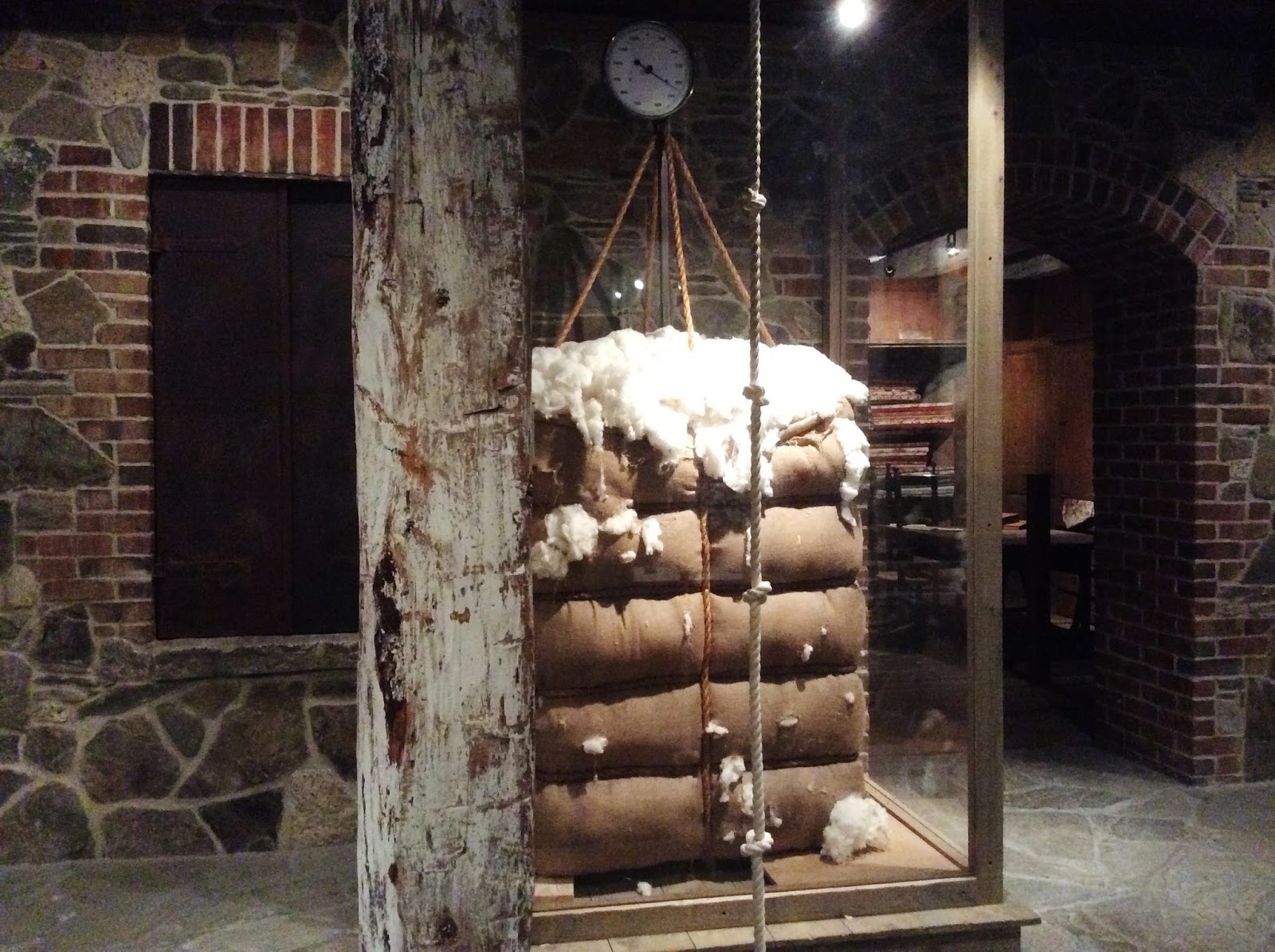
Welcome to the American Textile History Museum. Through these doors are period rooms, educational displays of how raw cotton or wool is made into thread or yarn and the collection of period clothes (as shown in my first post). Museum guide and my photos are below.


The lighting wasn't the best for photos, but I'm showing some of what I took.


Wool and Cotton


 Peeking through the window to see the general store, walk inside to see what was sold to customers (seen below).


This is a small working exhibit and they used to make items to sell in their gift shop. Things like place mats, dish towels, and napkins.

Loved the threads above and dyes below.


 Front and back of a bookmark.


IMPORTANT UPDATE: MUSEUM CLOSED FOR GOOD

(DATED June 14, 2016)

It is with a heavy heart that we inform you that due to a significant financial deficit, the American Textile History Museum will be forced to permanently close our doors.
This was a very difficult decision for all involved and certainly not the outcome we had hoped and worked for. However, due to serious operational challenges and financial shortfalls, our Board of Trustees has realized that this is the only responsible option.
All ATHM exhibits are now closed to the public; all programs and classes will be closed as of June 30, 2016. In the coming weeks and months, we will be working closely with the Massachusetts Attorney General's Office and Supreme Judicial Court to dissolve the Museum's 501(c)(3). You can learn more on our website about what lies ahead.
ATHM has begun the process to transfer our priceless collection to other nonprofit organizations able to serve as faithful, long-term stewards. Recognizing your interest and commitment to this collection, we will endeavor to share on our website the future homes of the artifacts as they are relocated. We are gratefully accepting donations towards the preservation of the collection as we relocate the artifacts in our care.
We sincerely appreciate your support of ATHM. We are sorry to share this unfortunate news and we thank you again for your support of this great museum.

UPDATE: For November 30, 2016.

http://www.lowellsun.com/news/ci_30617781/american-textile-history-museum-space-market

Wednesday, May 11, 2016

Notaries, A Friend Gives an Explanation.

All Saints Anglican Church, Dunham, Quebec
taken by Barbara Poole, 2000


Recently, I have been going through old research papers, and one had information about a service Pennie Redmile was offering to those doing research in Missisquoi Co., Quebec, Canada. I used her service, and we have remained friends since before 2003. Recently, I asked her if she would write a few paragraphs about Notaries. I believe my readers doing Canadian research will be interested in learning about them. Pennie is no longer doing this work, but she was willing to write about Notaries as a guest writer. Thank you, Pennie.


Notaries

Unlike other places, notaries in Quebec were responsible for many many transactions. Even to today, a will drawn up by a notary  does not need to be probated. --- Aside from wills, notaries were responsible for many  other transactions. It wasn't uncommon for a notary who worked for 40 years to have  over 100,000 documents. Aside from wills, there were marriage contracts, estate inventories (a complete list of holdings when a person died), indentures & apprenticeships, protests, (disagreements over anything from estate matters to business partnerships) all land transactions were handled by notaries, "gifts"  could be another, a father giving land or possessions to a son or daughter, or it could be a son promising to care for his parents for their lifetime. When  a person bought or sold an item -- even a horse or carriage --there likely was a   "sale".. When the army bought beef for the soldiers, there was a contract .Only once did I ever see an adoption carried out by a notary. The list is quite endless. There were many many hundreds of notaries in Quebec-- which makes finding the  records for a specific family quite daunting a task. The Montreal Archives have posted some notary indexes or repertoires to their website. An index was an alphabetical  day to day  listing of  each  transaction. However to locate a specific person , one must check the entire  listing for that letter of the alphabet. If a man had a marriage contract drawn up  & 40 years later had a will drawn up -- the two documents will be found in the time frame they were contracted.  A repertoire was a different book kept by the notary & was a day to day  chronological  listing of the events.  

Also --especially in rural areas , one will find  tutorships & curatorships in with the notary records. These are  court documents & was another fantastic provision  (not mandatory) that people could  benefit from.  When a  spouse died , the surviving  spouse could petition the court  for  a "tutor" & "sub tutor" for the minor children. The person would go to court & give  the name of the deceased  (maiden name if it was the mother)  & occupation & residence. They give the names of all minor children  & often their ages or dates of birth. If married outside Quebec, it will often state where the couple was married..  The petitioner  asks the court to appoint 3-5 men to choose the tutor. The names of the men are cited, their relationship to the minor children , their occupations & place of residence. These men  will choose a "tutor" (caregiver for the children) & it was usually the surviving parent. Then a "sub tutor" would be chosen from the men  & he would be  instantly responsible for the care of the children should the  "tutor" become ill  or die or etc.

The tutorships carry a great deal of genealogical information  & they are  held in the  nearest archives to the region  & are known in French as "tutelles". The curatorships are much the same idea-- but there are voluntary & involuntary curatorships. Some man who inherited money might request one --to have help in dealing with the  money. An involuntary  one could be a  a person who couldn't care for himself  being taken to court by family to see that he was properly cared for. It was usually family  who took on these responsibilities  when the need arose. The "curatorships" in French are called "curetelles" .


See: 
How to order a notary record from the Quebec Archives after finding it in an index on Ancestry on Gail Dever's Post dated Sept. 1, 2017, link shown below.
http://genealogyalacarte.ca/?p=20640

Thursday, May 5, 2016

Bedford, Massachusetts and Seeing the WWI Memorial Once Again


Bedford is rather close to where I live and I've been by the above memorial many times. However, the trees are usually casting a shadow or shining too brightly on the war memorial. However, I lightened up my photo, so it can be read. The names are below. (My original post, dated Dec. 17, 2012 mentioned I wanted to take a better photo.)
IN MEMORY OF
THE MEN OF BEDFORD
WHO GAVE THEIR LIVES IN THE WORLD WAR
AND IN APPRECIATION OF ALL THOSE WHO SERVED
TO THE CREDIT OF THEIR TOWN, STATE AND COUNTRY

*Alexander Robert Anthony     *Hugh I. Hunt      * William Walter Hamilton
Lionel Reginald Anthony
Vernon Richard Anthony
Abigail Bacon
Albert Bierenbroodspot
Andrew Cornelius Bierenbroodspot
Howard Drown Brawn
Charles Elmer Brock
Charles Elmer Brock
Thomas Butler
Roland H. Brown
Franklin Harwood Canlett
Arthur Everett Carson
Hermann Emil Christiansen
William James Crier
Frank Bellows Davis
Howard F. Davis
Clifford Louis Day, Jr.William J. Durkin
Michael Lawrence English
John Stephen Fanning
Basil Edward Fletcher
Milton Currant Ford
Benjamin Charles Freeman
Nicholas Genetti
Edward Loren Goulding
Arthur Holden Hayden
Gunnar Hemmingson
Edward Amos Hunnewell
William James Hunt
Henry Clare Isnor
William Jackson
David Theodore Keay
Francis Joseph Kelley
Henrick Hans Johan Larsen

Hubert H. Loomis
Ralph Loomis
Samuel Loomis
William F. Loomis
Francis Colin MacDonald
Walter Francis Manning
Johanna Elizabeth McMahan
Martin Francis McMahan
Philip Edward McMahan
Edward Joseph O'Dowd
Philip Stephen O'Dowd
Frederic Parker, Sr.
Henry McBurney Parker
John Stanley Parker
W. A. Parker
George Henry Peterson
J. H. Philbin
Fred A. Proctor
Paul Rhoderick Raymond
John Harold Riese
Nicholo Silverston
Peter Snyer
Frederick H. Sullivan
Nicholo Silverstone
Peter Snyer
Stephen Tackney
James J. Walsh
Rev. Arthur Stanley Wheelock
William Albert Wilkins
Harold Edward Willson


THE TOWN COMMON LANDS

WITHIN THESE LIMITS STOOD THE
FIRST MEETING HOUSE BUILT IN 1729
THE FIRST TOWN POUNT IN 1733
THE FIRST SCHOOL EST. IN 1741
THE BELL TOWER ERECTED 1753
THE MILITIA AND THE MINUTE MEN
USED THESE LANDS FOR THEIR
PARADE AND TRAINING GROUND

BEDFORD HISTORICAL SOCIETY 1969

The Old Town Hall, Built 1856
The town green, looking towards Great Road / Route 4
Meeting House of the First Parish Unitarian Church
Erected 1816
Boot Scrapers (above)

Additional posts about Bedford:

43 Revolutionary War Soldiers and Widow Balch Buried in Bedford, MA

Town green to the lower left, the library, police department and school to the right. (From Google earth.)

Tuesday, May 3, 2016

American Textile History Museum, What Was Inside?

"There is A Lot to Like About Lowell" is the city slogan.

(See tab on the right side called "Lowell Series" for many more articles about Lowell.)
The American Textile History Museum, on 491 Dutton Street, Lowell has been one of my favorite museums for many years, and for about five years, I volunteered there doing quite a few things. I always monitored the special exhibits, by answering non-technical questions, preventing photographs from being taken and watching what people brought in, like soft drinks, food and umbrellas. I did this every Thursday evening, from 6-8, as well when special events held on Friday or Saturday evenings in the function area (events such as company fundraisers, weddings, birthday parties, etc.), and assisted in the office of the volunteer coordinator. I met many nice women, some of whom I still see around the city.

Part 2 may be seen HERE. I have included the Museum Guide with a diagram of the building as well as a lot of period rooms.

Favorite exhibits of mine were the Princess Diana dresses (my post), a hat exhibit, Hawaiian shirts, several quilt exhibits and Hollywood costumes (my post with a photo of flyer for the exhibit).

Unfortunately, the museum closed the first of this year, and I haven't heard if or when they will open. If you ever wanted to see the exhibits, I can show you what I saw the week before it closed. I will do two posts, this one covers the clothes and accessories, in no particular order; the second will show the historical aspect of the museum next week.


IMPORTANT UPDATE: MUSEUM CLOSED FOR GOOD

(DATED June 14, 2016)

It is with a heavy heart that we inform you that due to a significant financial deficit, the American Textile History Museum will be forced to permanently close our doors.

This was a very difficult decision for all involved and certainly not the outcome we had hoped and worked for. However, due to serious operational challenges and financial shortfalls, our Board of Trustees has realized that this is the only responsible option.
All ATHM exhibits are now closed to the public; all programs and classes will be closed as of June 30, 2016. In the coming weeks and months, we will be working closely with the Massachusetts Attorney General's Office and Supreme Judicial Court to dissolve the Museum's 501(c)(3). You can learn more on our website about what lies ahead.
ATHM has begun the process to transfer our priceless collection to other nonprofit organizations able to serve as faithful, long-term stewards. Recognizing your interest and commitment to this collection, we will endeavor to share on our website the future homes of the artifacts as they are relocated. We are gratefully accepting donations towards the preservation of the collection as we relocate the artifacts in our care.
We sincerely appreciate your support of ATHM. We are sorry to share this unfortunate news and we thank you again for your support of this great museum.
--------------------
From LowellSun.com http://www.lowellsun.com/local/ci_30018045/


Lowell textile history museum will not reopen

by By Melissa Hanson, mhanson@lowellsun.com

"LOWELL -- Months of talks about a new business model with a local partner were not enough to identify a sustainable plan for the American Textile History Museum, as officials on Tuesday announced the museum's permanent closing.
The museum was primarily working with the Lowell National Historical Park to develop a strategic partnership that would help keep the museum afloat after nearly two decades of financial difficulty, interim Executive Director Todd Smith said.
Though Smith and Park Superintendent Celeste Bernardo planned a partnership of the two organizations, Smith said it became clear that in order to effectively work with the park, which receives federal funding, an organization would have to already be viable and sustainable on its own. The museum is not.
The museum examined other regional organizations for partnership possibilities, but the national park was its best option. Without a clear path for a new business model, museum employees shifted their focus to preserving and identifying a new home for the collection, which has hundreds of thousands of pieces, from objects as small as a sewing needle to those as large as a the towering green roller printer in its lobby.
Museum exhibits at the 491 Dutton St. location closed to the public on Jan. 1. The call was made by the board of trustees after it determined it was not feasible for the museum to continue operating on a shrinking budget.
After seven months, consultation from the Nonprofit Finance Fund and Laura Roberts Consulting failed to identify a viable business model to keep the museum running, the museum said in a statement. The museum is in the process of dissolving its 501(c)(3) status with the state Attorney General's Office and the Supreme Judicial Court.
"This was an extremely difficult decision for all involved and certainly not the outcome we had hoped and worked for," said museum board Chairman J.
One of the museum’s extensive collection of fabric sample books. This is the Hamilton Mills book from November 1883 to February 1884. Sun staff
One of the museum's extensive collection of fabric sample books. This is the Hamilton Mills book from November 1883 to February 1884.

Sun staff photos can be ordered by visiting our SmugMug site.
Matthew Coggins. "However, the board recognizes that serious operational challenges, financial shortfalls and other circumstances make it impossible to ethically and responsibly dedicate further financial assets to attempt to keep our doors open."
The museum was running through up to $800,000 annually, officials said. Its current endowment is $1.65 million. That money will be used to steward the collection to new homes, likely to multiple partners. But while keeping some parts of the collection together, it will not be enough to cover the entire cost.
"We are really hoping there are members of the community near and far who will feel that the long-term preservation of the collection is worthy of giving to," Coggins said in a phone interview.
Some dresses from the mid to late-1800s at the museum.Sun staff photos can be ordered by visiting our SmugMug site.
Some dresses from the mid to late-1800s at the museum.

Sun staff photos can be ordered by visiting our SmugMug site.
The museum has seven full-time staff members and several hourly contractors. For now, their focus will be on moving the collection, but once that task is complete the staff will be let go, Coggins said. It will take at least a year to complete that process.
Classes at the museum will end June 30.
Smith said the board and the museum staff have done nothing but "a spectacular job" with the museum, something also acknowledged by industry leaders he has spoken with during the process.
"It's been a very difficult process to go through, and this is certainly not the outcome that we had hoped for," Coggins said.
Financial difficulty has plagued the museum for nearly two decades.
Smith poses near cotton dresses from the mid-1800s.Sun staff photos can be ordered by visiting our SmugMug site.
Smith poses near cotton dresses from the mid-1800s.

Sun staff photos can be ordered by visiting our SmugMug site.
Since moving from North Andover to its current location in 1997, attendance and revenue have been much lower and operating costs much higher than projected estimates at the time of the move.
The loss is significant. The textile museum holds the world's largest collections of tools, spinning wheels, hand looms and early production machines, as well as more than 5 million pieces of textile prints, fabric samples, rolled textiles coverlets and costumes, according to its website. The museum was founded in 1960 and is affiliated with the Smithsonian Institution. It offered a core exhibit, rotating special exhibits, events, and online access to the artifact collections at www.athm.org
It's grim to see a textile museum fail in the birthplace of the Industrial Revolution, but Smith said the concept of a museum is not entirely dependent on its survival.
"It's more the execution of the business model and how it deals with the financial reality of serving that mission," Smith said in a phone interview.
Smith was appointed in mid-September, following the sudden departure of Jonathan Stevens, president and CEO, over differences of opinion with the board of trustees regarding the museum's future direction.
The museum is working with The Edge Group in Lowell to prepare to sell its 65,000-square-foot condominium space on Dutton Street.
Last year the museum had 20,000 visitors, slightly higher than the annual visitation for the previous years because of the attention to the "Wonder of Wool" exhibit.
Smith said officials plan to keep the museum's website up for at least a year after closing, and that the online collection will still be available for researchers.
Christopher Rogers, a member of the museum's Board of Advisors, said the closure is sad, but that his grandmother, Caroline Stevens Rogers, who founded ATHM in 1960, was a big believer in change when it is needed.
"She'd be the first to cry for a minute for the loss, but then say, 'It's been incredible. Look at all the good we've done,'" he said.
This was not the museum's first attempt at major change. In 2005, the board voted to restructure, permanently closing the Textile Conservation Center and selling part of its Dutton Street building for conversion into mixed-use space. The museum closed its exhibits and galleries to the public and launched a $3.9 million campaign to raise funds for a core exhibit renovation, endowment and operating costs. The campaign goal was reached and the museum reopened in June 2009.
Museums have struggled financially since the economic crisis in 2008, the museum's statement said. In the last year, at least 11 U.S. museums have closed.
The textile museum will still collect donations to support the hours necessary to transfer the collection to another organization for long-term stewardship. Donations will be accepted at www.athm.org/donate, by mail to 491 Dutton St., Lowell, MA 01854, or calling the museum and giving your credit card number over the phone.
"We are asking that all who share a love of and concern for America's history and heritage help us preserve and protect the museum's unparalleled collection of American artifacts," Smith said.
Follow Melissa Hanson on Twitter and Tout @Melissa__Hanson."
Read more: http://www.lowellsun.com/local/ci_30018045/lowell-textile-history-museum-will-not-reopen#ixzz4BeOrvIQ2