Pages

The Life From The Roots blog topics have changed several times since I began this blog in 2009. I initially wrote only about the family history I had been working on for 20 years. Years later, I was into visiting gardens, historical homes, churches, libraries that had genealogical collections, historical societies, war memorials, and travel/tourism places. I also enjoy posting autographs and photos of famous people I've met or have seen.

Along with my New England roots, other areas include New York, New Jersey, Michigan, Illinois, Wisconsin, and the Eastern Townships of Quebec, Canada.

Please check out the labels on the right side for topics (please note, they need work). Below the labels and pageviews is a listing of my top nine posts, according to Google. Four of them pertain to Lowell, MA. These posts change often because they are based on what people are reading.

Friday, November 17, 2017

What Did He do With all of his Money? He Built a Castle!

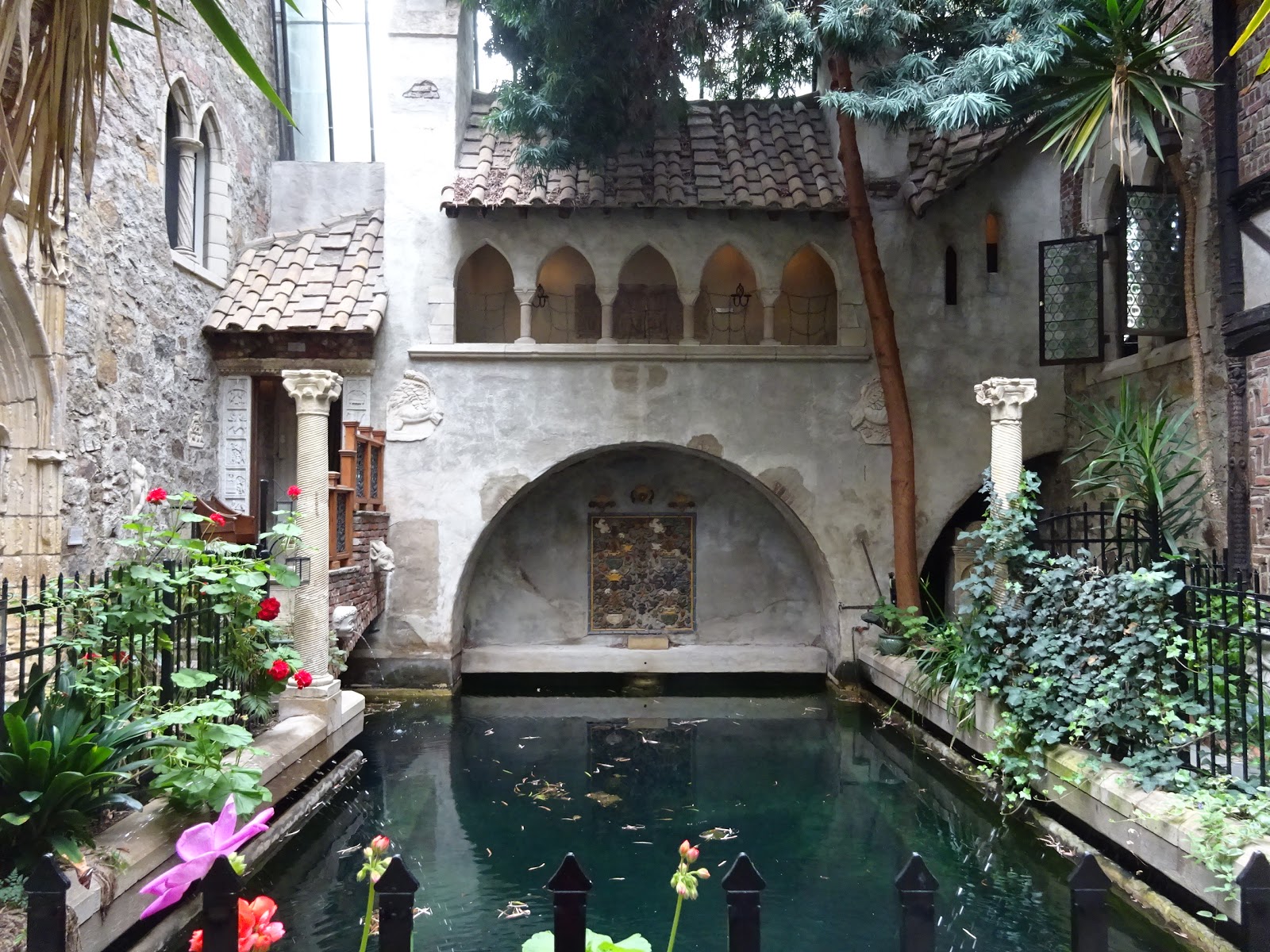
With so many lush green shrubs and trees, we could hardly see the castle as we walked down a long hill from the parking lot. Our visit was in May 2017. My last visit was over 55 years ago, and my memory was a blur. What delightful surprises; the sight of the Gloucester Harbor, lovely spring plants all around, colorful stained glass, and an outdoor courtyard in the middle of this huge medieval-style castle.

So who had this built? From the flyer we were given, "John Hays Hammond, Jr., while living in Washington, D.C. met Thomas Edison, who in turn introduced John to Alexander Graham Bell. Under Bell's guidance, he worked three years as a clerk in the U. S. Patent Office." His calling was in his inventions and various occupations during his lifetime. He developed a radio guidance device for pilot-less ships, "with nobody on board, which immediately got the interest of the United States Navy." "He is credited with 800 inventions and 437 patents." From Wikipedia: He is "an American inventor known as 'The Father of Radio Control'. Hammond’s pioneering developments in electronic remote control are the foundation for all modern radio remote control devices, including modern missile guidance systems, unmanned aerial vehicles (UAVs), and the unmanned combat aerial vehicle (UCAVs)."

The castle (with his laboratory) was built as a bridal present for his wife in 1926, they moved in, in 1929 and opened it as a museum in 1930.

Entrance over the drawbridge.

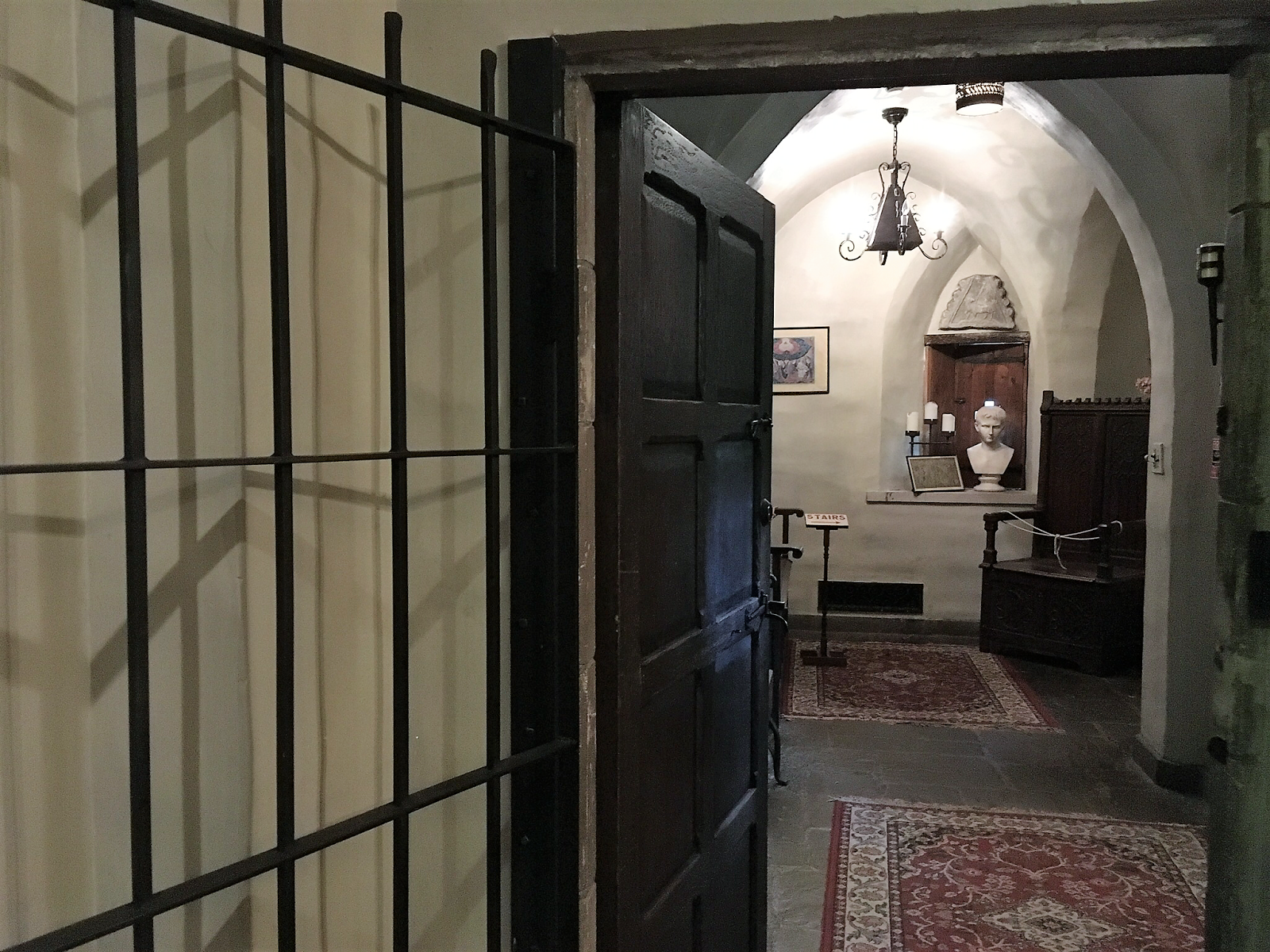
Door to the drawbridge and photos of the hallway are below.
Above photo, drawbridge door to the left.
Medieval style hall and rooms with Roman, medieval, and Renaissance artifacts.


Right by the chair, is a very narrow, circular, staircase to the lower floor.

The group of photos below are on the lower floor.


Below 4 photos taken on first floor, near sales counter and gift shop.


Early photo of Hammond Castle on display.

My favorite area was the courtyard.


My husband took this lovely picture.

Back and side views of the castle and property.


This museum is Not handicapped accessible. For more information, see below.


Wednesday, November 15, 2017

Visit to the 1715 Parson Barnard House, North Andover, Massachusetts


I have passed by this house many times during the past 22 years, and finally took a tour of it, during an open house on August 2017. Photos are from over the years. From the flyer, shown at the end, it tells me that, "Each room in this house represents a different period, from 1715 to 1830. Only the four front rooms are open to the public." My first group of pictures are of the house and exterior. The room photos follow.


The barn photos are below. It is being renovated, but I was fortunate, on a recent November day, to get a peek inside because two carpenters were working, and let me in. I didn't take photos, but I can tell you, it will be beautiful, and I look forward to seeing it finished.

Above is the parking area, and the yellow house is the Parson Barnard House.


We saw four rooms, the photos are shown below. Our guide was very busy, and we missed quite a bit of what was being said. More about the house HERE.


Signs below are in the parking lot. Parking is tight because there is no parking on the main street. Parking is available next to the barn, the barn shown above.


The Parson Barnard House belongs to the North Andover Historical Society.
Old North Parish Burying Ground
North Andover, Massachusetts


My 2014 post is about my visit to the Society's archives and historical records collection. Take a peek at what their library looks like. There is a list of the original settlers shown.


Thursday, November 9, 2017

The Well Known Veterans I met through Work


"The Vietnam War" shown on the Public Broadcast Station (PBS) is a ten-part, 18-hour documentary film series directed by Ken Burns and Lynn Novick. It was shown on tv in September, and because it was shown over 10 days, I missed a few episodes, but watched them a few days later on another PBS station. The Vietnam War was released on Blu-Ray and DVD on September 19, 2017 and I believe most large libraries will carry the DVDs.

The early history was very interesting, and from what I heard from friends, we all learned quite a bit. However, the era from about 1962-1975 interested me the most. It was during those years that I watched the battles play out almost every night on the news, marched in protest 1969, and heard on the radio, while I was in the service in Virginia, that Saigon fell.

Later years, I worked in two medical facilities; Walter Reed National Military Medical Center and the DeWitt Army Hospital at Fort Belvoir, Virginia. Later, I worked at the Department of Veterans Affairs headquarters in Washington, DC for about 6 years, I came in contact with many veterans, some as patients and others just working there, like me.

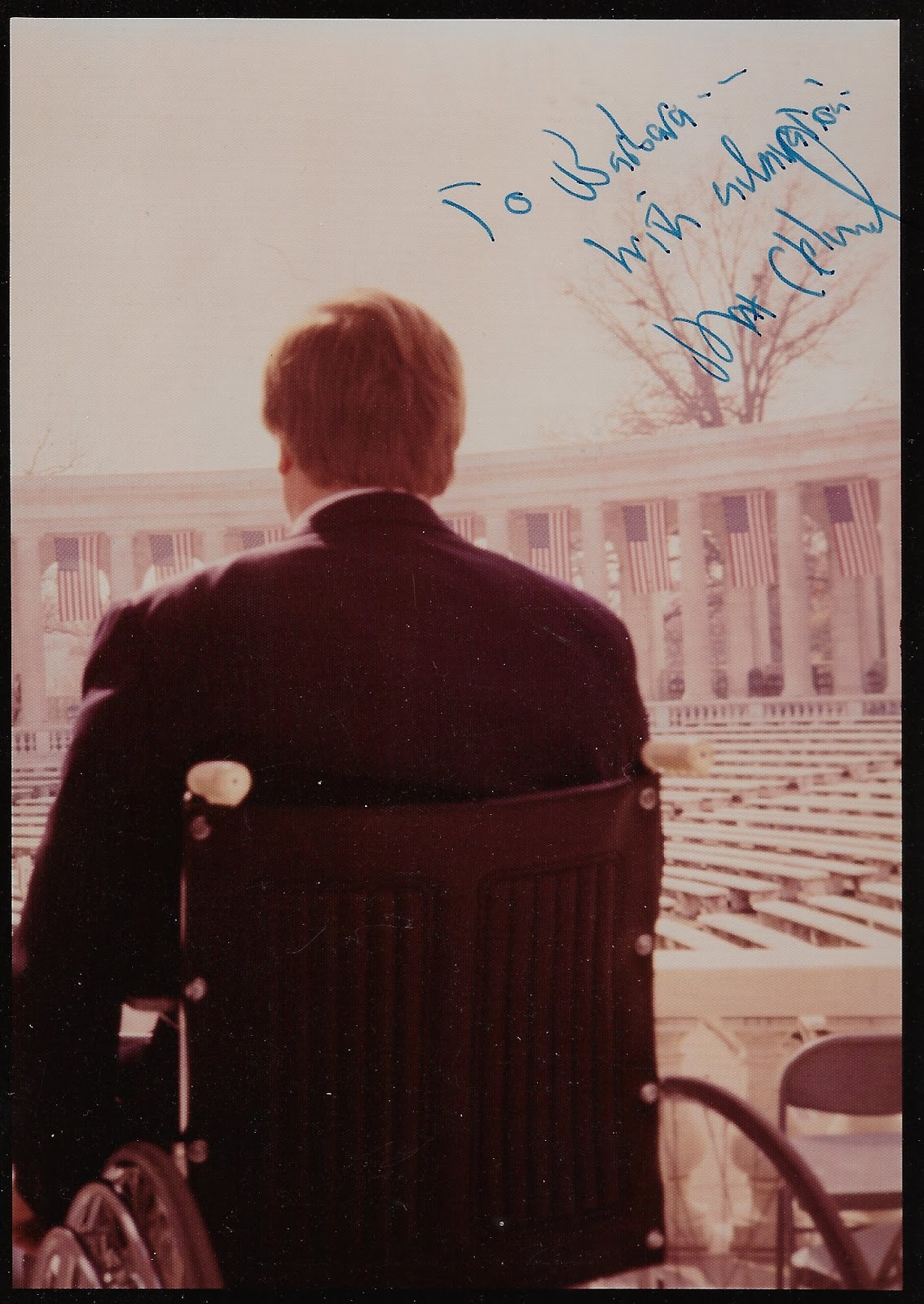
Among the veterans I worked under, one was the Administrator and the other a Deputy Administrator of the Department of Veterans Affairs, both of whom were on the "Vietnam War" show. I was fortunate to meet both of them, and got autographs, as shown below.


The Wikipedia link (above) states, "Everett Alvarez Jr. (born December 23, 1937) is a former U.S. Navy Commander who endured one of the longest periods as a prisoner of war (POW) in American military history. Alvarez was the second U.S. pilot to be downed and detained during the Vietnam War and spent over eight years in captivity; making him the second longest-held American POW." He was the Deputy Administrator at the Department of Veterans Affairs for six years, from 1982-1988. (I worked there 2 of those years.)


Max Cleland (above and below)

Max was a captain in the Vietnam War, and a month before the end of his tour, he was badly injured, which later resulted in having his legs amputated above the knee and his right forearm. He was 25 years old.

Years later President Carter selected him to be the Administrator of the Department of Veterans Affairs from 1977-1981 (I worked there 3 of those years). He always had a smile, was quite personable, remembered everybody's name, and drove his own car to work!
I believe we were celebrating the day when the 15-cent Veterans Administration commemorative stamp was first placed on sale at Washington, DC, on July 21, 1980.

The third veteran, in The Vietnam War series, I saw in person was John Kerry. He and John McCain were shown in the series, but not interviewed. John Kerry often came to Lowell, his old hometown where he tried to get into politics. It was years later, he ran for both state senator, and then president, and I saw him when he campaigned in Lowell.

In addition to the three above veterans, I was very fortunate to see Omar Nelson Bradley, a former General of the Army and Administrator of the VA. He paid a visit to the VA headquarters, in a wheelchair when he was between age 85 to 88 years old.

Not a veteran, but I did see Mamie Eisenhower in the gift shop at the Walter Reed Hospital. I was luck to get a heads up, when I saw her chauffeured car with 5 stars on the license plate, parked in front of the side entrance. (Between 1977-79, she died in Dec. 1979.)

Another individual in The Vietnam War series was President Lyndon B.  Johnson. He was not a veteran, but I thought I'd show a few photos of his ranch, his tombstone, and me with a statue of him at the ranch (1975). A FindAGrave.com photo of his tombstone is HERE.


The above veterans mention are just a few of the many who served or who are still serving. It is because of them that we honor them on Veterans Day.

Two past posts:
A Prince and a Princess on Veterans Day ( Diana and Charles)

President Carter and Arlington National Cemetery on Veterans Day


Monday, November 6, 2017

"On Learning To See," and I have David McCullough to Thank for the Poetry Challenge Idea

Church and tombstone of
Dr. Manasseh Cutler
For the past eight years, Bill West of West in New England blog has his Annual Great Genealogy Poetry Challenge. The fun that comes from this challenge is, I need to find a poem that has something to do with genealogy or an ancestor or distant relative with perhaps history or genealogy in the theme.

For my 7th annual poem I chose On learning to See by Jack Metthews. My poem idea was based on the fact that I learned, from a facebook friend, that David McCullough was writing a book with some information about my ancestor, my 5th great-grandfather, Manasseh Cutler! A little magical google searches brought me to this poem!


"McCullough is working on another book, 'The Pioneers,' which is scheduled for a 2019 release. The book will tell the story of the courageous first settlers of the Northwest Territory in the late 1700s and early 1800s, including Ohio University founder Manasseh Cutler."
My 2nd great-grandfather also wrote a book about Dr. Manasseh Cutler:
Poole, William Frederick, The The Ordinance of 1787, and Dr. Manasseh Cutler, Welch, Bigelow, and Co., University Press, Cambridge, Mass. : 1876. (Google book.)  I assume Mr. McCullough will use this book.

ON LEARNING TO SEE

By Jack Matthews

Ohio University's my theme,
An institution intellectuals planned
When Ohio was a wilderness, for they deemed
This to be the time and this the land.
It remained in isolation as it matured,
Silent and remote from most appeals
Of fame and noise, and in this way abjured
The insidious power that relevance conceals.

By nature universities aspire
To that which some in part achieve by chance;
But we far more than most this end acquire--
Being an institution of irrelevance.
What perspective is better from which to see
The world than from some vantage point apart?--
For this remoteness in itself will free
The mind and with it liberate the heart.
Without some distance, nothing can be known;
There is no fixedness without some motion;
Knowledge derives from antithesis alone--
No fish could ever understand the ocean.

Great numbers of distinguished men and women
Have studied in these halls; but I will summon
Only one who did not study here at all,
Yet left his mark indelibly, withal.
I speak of Manasseh Cutler, eponym
Of Cutler Hall, that still remains a hymn
Of architectural elegance, one Jefferson 
Himself would have put his name upon.

For Manasseh Cutler was a man
Much like Jefferson in his great command
Of knowledge--of philosophy and plants,
Of engineering, theology and dance,
Of physics, poetry and classic drama,
Of grammar, syntax, the function of the comma.
He was, in short, un Uomo Universale,
And as much as any human exempt from folly.

He understood the complexity of things
And how much satisfaction knowledge brings.
He understood the molecule and atom
And sensed those elements too deep to fathom.

So how do you open a university?
Manasseh Cutler did it with a key--
To wit, he consulted and studied the college charter
Of several, including Yale, his Alma Mater;
So our "Harvard on the Hocking"--as some have hailed it--
He patterned on its nemesis, he yaled it.

It was in his encyclopaedic brain
That a university was born, to gain
Its true and plenary self beyond his knowing--
As always the richest seed transcends its sowing.
This impulse in his mind became the brick
Of buildings in which debate, arithmetic
And botany were passionately instilled
In the young, ambitious to be skilled
In eastern sophistication, while retaining
Some frontier innocence and remaining
Idealistic in the firm belief
That in knowledge, and that alone, is our relief--
visionary in their firm conviction
That wisdom is the ultimate benediction.

For learning of this sort to be completed
a passionate attentiveness is needed.
We need the world of things to love and study
As surely as the mind requires a body.
To fervidly attend to what's provided
By a teeming world of things is to be guided
By the instinct of the mind, the signal feature
Of that thinking reed, the human creature.

How much there is we see but do not see;
How often things are instruments that we
Fail to honor with that rapt attention
The world deserves--I speak of deep absorption,
Of profound allegiance to the morality
Of understanding; I speak of responsibility;
Of how it is through learning that we seek
To better understand the world; I speak
Of Manasseh Cutler, whose son reported that
"He learned to see what he was looking at."

I obtained permission from reference librarian, Julia Robinson, to use this poem from Ohio University. I only wish the author, Jack Matthews could have been thanked personally.  Credit: https://www.ohio.edu/bicentennial/history/tributes/poem.cfm

"The following poem was commissioned by Dean Leslie Flemming of the College of Arts and Sciences to be read on the occasion of the Distinguished Alumni Ceremony on September 19, 2003 in the Baker Center Ballroom. The poem and preface were published in the program for the evening. 

Preface

A preface to a short poem can betray fecklessness or self-infatuation. And yet, prefaces can also be charitable acts, calculated to prepare audiences for what's in store for them, which is merciful insofar as poems are often perplexing when they are heard rather than read. So it's this I have in mind in providing the following introduction:

How can one pack the life of a 200-year-old university into a poem? Best not try, is the prudent answer; but, here, prudence is of limited usefulness; so that, when I was asked to do precisely this, I was happy to throw myself into the task. The result is a 2-page poem (if I had striven for historical balance, that would be one page a century) of closely rhymed pentameters.

Why rhymed? Because it is focused upon that gifted renaissance man who, in effect, started it all--Manasseh Cutler; and the verse most appropriate to him is that which he would most likely understand and appreciate if he were to hear it. More than that, however, such closely rhymed verse announces itself defiantly as artifice, rejecting the latent imposture of unrhymed, unmetered verse as a simulacrum of living speech, for poetry is not speech, but an elaboration upon the artifice of speech.

In addition to all this, however, to the modern ear there's always something faintly playful, frolicsome--even hilarious--about closed rhymes. It's hard to take them altogether seriously. Laughter is in their echoes, as surely as in the syllables, "Ha ha!" But no intellectual worthy of the name would ever deny the importance of laughter, for more often than not, laughter is nothing but a response to irony, and irony is intrinsic to language itself; and language defines our world."

Tributes

"Just learned in the spring 2014 obituaries of the passing of John “Jack” Matthews, Distinguished Professor Emeritus of Creative Writing at OHIO."

Two posts of mine, with photos, previously written:
Dr. Manasseh Cutler - A minister, doctor, statesman, botanist and ancestor

Hamilton Cemetery and Manasseh Cutler, the most accomplished of all my ancestors