Pages

The Life From The Roots blog topics have changed several times since I began this blog in 2009. I initially wrote only about the family history I had been working on for 20 years. Years later, I was into visiting gardens, historical homes, churches, libraries that had genealogical collections, historical societies, war memorials, and travel/tourism places. I also enjoy posting autographs and photos of famous people I've met or have seen.

Along with my New England roots, other areas include New York, New Jersey, Michigan, Illinois, Wisconsin, and the Eastern Townships of Quebec, Canada.

Please check out the labels on the right side for topics (please note, they need work). Below the labels and pageviews is a listing of my top nine posts, according to Google. Four of them pertain to Lowell, MA. These posts change often because they are based on what people are reading.

Tuesday, August 10, 2021

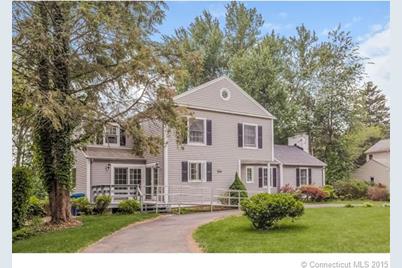
The History of the House my Grandfather Built as shown in Photos, 5 Christmas cards, His Architect's Home Description, and a Recent Listing.

Do you know the history of one or more of your ancestors? In my case, I just researched the house my grandfather built in 1949. The address has always been the same, but it has been listed in three different towns. I recently discovered this when I googled his house. Wow, the house is now in Berlin, CT, not New Britain or Kensington as in the past. I decided to look at some of my handmade Christmas cards he made to see what they had for an address. He built this in 1949, his second-built home. His first built house in 1930 was covered in my post called 90 Adams Sreet, A Very Special Place (I was born there). My grandfather left me a good trail, but I had to find the clues. It helped that he was the architect.

No date with this card, but it is probably before 1952, based on my grandmother's death. Here they were in New Britain, CT.

A year later my grandfather was remarried, so this must have been 1953 since he was working in NYC, but also living in Kensington, CT.

He often used his house as his design for Christmas. Other cards are shown below.


Photo card, undated. Annual Christmas message on the back.

My grandfather had a sense of humor and was into Star Wars. He even put his age on this card, can you find it?
Annual Christmas message on the back.

This 1976 painting shows his backyard on a snowy day. About 11 years ago, my husband and I went to the house and I gave the new owners this painting. They were delighted.
My grandfather having fun in 1950, in front of his house. All Christmas cards show a circular driveway, so he made that change after he moved in.

My grandfather wrote up a detailed description of his 1949 house. There are so many unique features, he didn't skimp on anything. I especially liked the cold storage room, I seem to remember it was lined in cedar, and that was where my grandmother stored her fur. When my grandfather died, the female relatives could take what they wanted. (I do believe he made a mistake in the description of the cold storage, it should have been "never goes below 32ยบ", it should read "goes above.") We used to freeze in that room.

The "An Architect's Home" has been in my possession since his 1980 death, and I thought it was written at the time he completed the house in 1949. Turns out, I was mistaken because there is a 1978 date at the bottom, which means he must have been thinking of selling the house. It sold for $82,000 in March 1982!


Of course, we all had to have a map to get to his new house. I believe there was much confusion because this was to the second town, Kensington.


When I googled the house, there was an active link for the house showing 36 photos and a detailed description.   https://www.realtor.com/realestateandhomes-detail/62-Chatham-Rd_Berlin_CT_06037_M48895-69375 

This is a snippet from one of the 36 photos. The red and white open bookcase on the left was what my grandfather used for his piano music and photos. There is another bookcase on the opposite side of the fireplace.
I took this family photo in 1956. It is the same room as the snipit above. The window behind my father was removed and the room enlarged.
  • Sold
  • Closed
  • Single Family
  • 5 Beds
  • 3 Full Baths
  • 1 Partial Bath
  • 2,699 Sq. Ft.
Impressive, Stately Colonial located in the Kensington section of Berlin and within walking distance to Shuttle Meadow Country Club. This house is extremely spacious....walk inside the front door into the formal foyer area. Large remodeled kitchen offers plenty of cabinet space and is open to the large dining room area. The formal living room includes a fireplace and overlooks the gorgeous backyard. You can also enjoy the yard from the three-season porch which opens onto a lovely patio. The family room is tremendous. From the high ceilings to the incredible stone fireplace, you will love spending time in this area of the house. Upstairs are the four bedrooms. The master bedroom includes a full bath and a walk-in closet. The lower level of this house includes an in-law apartment. It has its own separate entrance and includes a living room, kitchen, full bath and bedroom. This apartment can also be changed back to a 1-car garage as well. The flat backyard offers many possibilities for either gardening, a play set, or a pool. Great location.....very convenient to all major highways. Welcome home!


for 62 Chatham Rd

GENERAL

  • Sold For: $325,000
  • Taxes: (7/14-6/15)
  • Status: Closed
  • Type: Single Family
  • MLS ID: G10055335
  • Added: 2, 227 day(s) ago

INTERIOR

  • Number of Rooms: 10
  • Interior Features: Fireplace, Sauna, Smoke Detector(s)
  • Number of Fireplaces: 2
  • Appliances: Dishwasher, Oven/Range, Refrigerator

ROOMS

bathrooms

  • Total Bathrooms: 4
  • Full Bathrooms: 3
  • Half Bathrooms: 1

bedrooms

  • Total Bedrooms: 5

other rooms

  • Laundry: First Floor
  • In-Law/Au Pair Suite: Separate Entry

EXTERIOR

  • Exterior Features: Garden Area, Patio, Porch-Enclosed

PARKING

  • Parking Features: None
  • Garage Description: None

LOCATION

  • Area: Berlin
  • County: Hartford
  • Neighborhood: Kensington (23)
  • Driving Directions: High Road to Simms to Cornwall to Chatham

SCHOOL INFORMATION

  • Elementary School: Mary E. Griswold
  • Middle School: Catherine M. McGee
  • High School: Berlin

COMMUNITY

  • Community Name: Kensington

HEATING & COOLING

  • Cooling Type: Central Air
  • Heating Type: Warm Air
  • Heating Fuel: Natural Gas
  • Water Heater: Natural Gas

UTILITIES

  • Oil Tank: Non Applicable
  • Sewer: Public Sewer Connected
  • Water: Public Water Connected

STRUCTURAL INFORMATION

  • Architectural Style: Colonial
  • Exterior Const.: Vinyl Siding
  • Basement Desc.: Full Basement with Walk-Out, Partially Finished
  • Attic: Yes
  • Disability Adopted: Yes
  • Disability Access: Bathroom Grab Bars, Ramps
  • Square Feet: 2,699
  • Sq. Ft. Source: Town Records
  • Year Built: 1949


Thursday, August 5, 2021

First and Third Cousins Sharing Their Old Family Albums, and Look What I Got!

My first Poole cousin shared many of the photos with me in 2021.

In December 2001, I received an email from a rather young researcher inquiring if I was related to a particular member of his Poole family. David found me through a Rootsweb Gedcom and provided quite a bit of information about his line. We emailed back and forth several times and he reluctantly shared some photos of his line, which I am showing at the end of this post. It wasn't his album and the owner wasn't keen on his sharing. David and I are third cousins once removed. When family trees online came into our lives, I often thought about these pictures, but always kept them private. We didn't correspond again until I wrote him recently, fortunately, he had the same address and email.

In the past few months, I have been talking genealogy with my two first cousins, one living in Illinois and the other in Colorado. I met the Illinois cousin when she was about three in 1953 at our grandfather's house. Several years ago, she and her husband photographed a large family album, with about 100 small pictures all glued on! Each page was sent to me, but it was put aside until now since I did no genealogy last year. I knew it would be a big project because I couldn't read some writing and it was difficult cropping individual photos out of groups of 4 or more tiny pictures.

This year through a discussion with my two cousin sisters, I learned they were going to get together and plan to talk about their genealogy. Since I am a first cousin, with a lot of information, and they have the album, I told them I would send quite a bit of information to them before they meet. They don't use a database like my RootsWeb. I'm not sure either about FamilySearch.org or the other genealogy companies, I won't name them.

I realize these albums and the story will mean little to anybody else, but it is important to me to share what I have and what they have, and our relationship with each other. The lineage chart was done in order to figure out their relationships for this post. I wish more writers would do lineage charts to help readers follow their complicated family stories.

William Frederick Poole and his wife Fanny (Frances) Gleason. I can't tell which of the two photos of him is the oldest. I think he is younger than the below picture. He is one of my most famous ancestors. I've written a lot about him, but here is Wikipedia's information.

There are many photos of William, see my post The Aging of My Great-Grandfather. Now I have a few additional photos to add.

Clarence Frederick Poole was my grandfather. His wife was Marjory, her name and ancestry aren't shown, because I didn't want anything about my father shown. I have photos of two grandparents (Clarence and Marjory), two greats (Charles Clarence Poole and Anna Poole), four great-grandparents (Charles, Mary, William, and Frances), and two great-great-grandmothers (Eliza Cutler Poole and Elizabeth Wilder Poole).


I believe the oldest photo is of Eliza Cutler Poole, dau. of Manassah Cutler (Wikipedia article) who was born on 4 July 1779 and died on 22 April 1854. Mother of Charles Henry Poole.
Mary Abbie / Abby Daniels Poole (wife of Charles Henry Poole) Born 5 Feb. 1825. Below, she is with her granddaughter, Frances.

Nurse Frances and the Flu was a popular blog post of mine, it might be of interest to you.


I'm not sure if we ever met, but I was lucky to inherit my great aunt's dining room table when my mother died in 1990. Dorothy died in 1965 in Florida. Her death was noted in my diary which I still have.


Charles Henry Poole went to West Point. He married Mary Abbie Daniels, her father was Stephen Daniels of Salem, MA. (There are six direct lines of Stephen Daniels in her line.) He was a civil engineer and surveyed San Diego, Roxbury, MA, and Long Island, MA. Also wrote the 250+ page manuscript of the Poole family located at the New England Historic Genealogy Society, and I copied it, and then a friend transcribed it for my blog.


Charles Clarence Poole married Annie Poole, they were my great-grandparents. He was a patent lawyer.

Annie Poole and Charles Clarence Poole, perhaps before they married. At least some names were clearly written with dates in this album.

My Great-grandmother, Annie Poole married Charles Clarence Poole in 1884.

Clarence Frederick Poole, my grandfather. He was a patent attorney like his father, Charles Clarence.

I feel this is a sweet page. The pictures at the upper right show of my grandmother Marjory Adams Poole holding my father in 1919. I have the original photo, so apparently, copies were made. The photo below was enlarged so you could read why these pictures were taken.


Below are photos from the second album. I selected just a few to show.

The Family of William Frederick Poole, his wife Fanny, daughters, Alice and Anna (their husbands), son William Frederick and grandchildren.

Elizabeth Wilder, mother of William F. Poole
Born 1801 in Keene, New Hampshire
Died January 1859 in So. Danvers, Massachusetts

Two photos of Alice Poole, born in 1855. She was a sister of Annie.
 

Thursday, July 22, 2021

My Clothes History Through Photos and Diary, (1964-1978)


I was addicted to new and stylish clothes from the time I moved away from home in 1964. Up to that year, I disliked almost everything I was told to wear, including Jr. and high school. Fortunately, I was able to change my wardrobe when I got a job. I wasn't aware of how much clothes meant to me until I read my old 5-year diary and looked at some old photos.

When I was a child, my mother made all my clothes and we, along with my sisters were often dressed alike. I always hated that. Evidence of her work is below. But in her defense, she probably loved sewing because she graduated from Skidmore College with a degree in textiles, and had a nice sewing room.

The above and below are two family reunion photos, see three siblings dressed alike.
Christmas picture and an Easter photo. I was 13, didn't even believe in the Easter Bunny, and had to wear socks!

Eventually, I found my own style because I learned to sew, not from my mother but from a school class and a Girl Scouts troop. When I was in high school and had a little babysitting money to buy an outfit or two, or even purchase material, I grew away from clothes my mother made. In one of my journals, I wrote the following, I always remember wearing a girdle, even though I was about 110 lbs., a garter belt to hold up my stockings because pantyhose hadn't been invented. I always wore a slip, wore leather gloves a lot, and my pocketbook usually matched my shoes. I remember my grey and very thin striped white coat, my red pocketbook, and red shoes, this was a favorite outfit of mine. I must have worn red shoes in my senior year because it is mentioned in the yearbook!

When I went out to a fancy place, I wore a Jackie Kennedy-style hat. 

I didn't do any dating until after high school, so I wasn't trying to impress anybody with what I was wearing. I just loved clothes. My favorite colors were blue and pink, but I wore other colors, solids, and flowery prints. My favorite two outfits were pink and white checked-tight pants and the first dress I ever bought. It was a long-sleeved straight dress that fitted me all over like a glove. The only problem was the long zipper at the back. It was made of thin wool fabric and came with a short cape that I sometimes wore.


When I began my 1964 diary I wrote faithfully every day, except when I took vacations.  My purpose for sharing this is to share pieces about my obsession with clothes.  I had no idea I wrote so much until I wrote this blog and looked at the diary, which had been packed away for 40 years. A few entries are:
April 1964 2, bought a light blue spring wool coat.
A parka with a real fur hood was bought on Dec. 18, 1964.
The cranberry two-piece wool outfit, the jacket, and pants were bought on Aug. 6, 1965.
On May 31, 1966, bought a light blue raincoat.
In March 1967, bought my 3rd spring coat, a green one
In October 1967, I bought a Navy pea coat at Lemkins.
In April 1968, I had a tailor shorten three of my spring coats. (Yes, the styles were getting shorter, I had to be in style.)
November 1968, I had the real Persian trimmed grey winter coat shortened, that bought on Jan. 16, 1967.

I also wrote about the Christmas dresses I made, I think I made a dress for four years in a row. In November 1968 I made a navy wool dress (no memory at all of that). Another dress was green.


My two friends and I were waiting for a bus on June 4, 1964, to take us to NYC for four nights. We went to the Ed Sullivan Show, Macy's, Greenwich Village, RCA Music Hall, Central Park, World's Fair, Chinatown, and the Empire State Bldg. My diary indicated I bought this lime green spring coat at Lempkins in April 1964.

My roommate, Merilyn for two years before she got married, and I were on a double date. I bought this cranberry two-piece outfit and my roommate bought a set in green. But, of course, I had to buy a suede jacket (above) and below, the white boots for walking!

My then-boyfriend, later husband, took this picture of me, wearing the parka with real fur on the hood.

In 1967, I spent a few nights with my best friend in Cambridge, MA. This dress came to my knees, so it wasn't too short. It was a Jackie Kennedy-style dress, I thought. It was all lined, which was unusual.

A girlfriend took this photo of me in Montreal when we went to Expo 68. We didn't wear sneakers and pants in those days.


I had a lot of boyfriends and did a lot of dating as as shown on the above list. I don't know when I typed this up, but probably more than 25 years ago because I haven't had a typewriter since then. The above year was 1968, and the information was taken from my 5-year diary. This was done to help me remember what I was wearing and with whom. Nope, I couldn't wear the same outfit two times in a row! I love knowing when I saw "The Graduate."


This beaded bag was a purchase from a Lowell store in the mid-1960s. I used it when we went to formal dances. I also had two black ones, one a clutch and the similar to the above one, but no beads.


The date on the side of the photo is  April 1971. I loved this camel coat, it went to my knees, and I wore it with matching lined pants. This was my favorite date outfit for the winter. My then-boyfriend, now husband, took this photo.

The oldest outfit I still have and frequently wear, is this cotton Nehru style jacket, by Jones New York, shown below. It came with matching pants that I no longer have. The second photo shows how much it faded, by looking at the belt that I never used. I bought it while I was in the service, so it was purchased before October 1976 (while I was still in the service)....Best purchase ever. (June 2026, I still wear it.)


The above are ordinary black heavy dress pants. I wear them out, but have to hold in my stomach! If Liz Claiborne had only put elastic in the waistband, I'd be happier.

Wednesday, July 14, 2021

Did I Find a Genealogy Clue From The Address Book? Will You?


I was more than pleased to find a huge selection of newly printed books in large print at my local library. One book caught my eye and I knew I had to take it out, even though I knew nothing about the author nor the topic. I never thought about how addresses came about but found many of this author's stories very interesting. When were many of the street names and numbers developed and what were their origins? The author, Deirdre Mask answers this question in one of her 14 chapters. Beginning with The Development and Origins of street names in the Slums in India, Haiti, Rome, London, Vienna, Philadelphia, Korea and Japan. In the second category, she discusses politics regarding street names in Iran and Berlin. The fourth category covers race in Hollywood, Florida, St. Louis, and South Africa. Class and Status is the last category and it covers Manhattan: How Much is a Street Name Worth? and Homelessness: How Do You Live Without an Address?

My large print book was over 400 pages, so I skimmed some. I loved the part about West Virginia and learned that many towns didn't have street names. "For generations, people had navigated West Virginia in creative ways." They described the area where somebody lived, like near a white church, the brick church, the old post office. Can you imagine being a genealogist years ago searching for your ancestor's roots and not having a street name? I never thought about the problems you could have if you didn't have a street name or a number. How can you receive a credit card, visitors, Amazon packages, etc.

There were many sections that I thought a genealogist or a lover of maps would be interested in this book especially when I read, "An adviser to George Washington, Clement Biddle devised this system in 1790 when Philadelphia was conducting a census. Odds on one side evens on the other takes much of the guesswork out of knowing how far a number is along a street." The information about naming the New York City streets from First Street to 155th, the avenues from First to Twelfth. "Numbered streets are a peculiarly American phenomenon. Today, every American city with more than a half-million people has numerical street names. "Second Street is the most common street name in America. "There was a large section about William Penn and Quakerism. I learned that "in some years, more than 40 percent of all local laws passed by the New York City Council have been street name changes." Wow, good luck trying to find somebody there. What about names, especially in the 1700s in England when 90 percent of men had one of only eight names: John, Edward, William, Henry, Charles, James, Richard, or Robert. Good luck if you are researching somebody who lived on 37 King Streets, 25 Victoria Streets, 34 York Streets, 37 Edwards Streets, or 64 Charles Streets or 64 New Streets!

In the author's Notes on page 519, she mentioned Their Gothic Revival cottage, built by an old Dutch family: Tom Miller, "The Lost Ten Eyck House--Park Avenue and 34th Street," and said, "Miller's fantastic blog details the history of the house at length." I am sharing a part of this article because Ten Eyck was my grandmother's maiden name.

"On January 7, 1859, The New York Herald announced that no longer would "the New York and Harlem Railroad Company, or any other company or person" be permitted to run "steam engines or locomotives on Fourth avenue, below or south of Forty-second street."  The new regulation was in response to what today would be called a class action suit by residents in the recently-developing neighborhood.  Listed among the plaintiffs were "Peter Ten Eyck and Margaret Ten Eyck, his wife."  Peter, in fact, had initiated the proceedings.

The Ten Eycks had personal reasons to oppose the locomotives.  They had erected a commodious and charming home on the northeast corner of 34th Street and Fourth Avenue two years earlier.   The Gothic Revival residence no doubt took its inspiration from the 1842 Cottage Residences, by Andrew Jackson Downing.  The book was highly responsible for the popularity of the Gothic Revival style in domestic architecture.

An example of a Gothic house from the 1842 Cottage Residences.  (copyright expired)

The Ten Eyck house was clad in red brick, its openings trimmed in stone square-headed drip moldings.  Gothic tracery dripped from the eaves, a picturesque oriel clung to the eastern corner, and a high stoop led to the ornate pointed-arched doorway.

The Ten Eyck family had been in America since 1650 when Coenraedt Ten Eyck (was my 8th grandfather) and his wife Maria arrived from Amsterdam.  Peter had married Margaret S. S Troutman in 1843.  She was the daughter of Sir John Troutman of the British navy.  Decades later, in 1881, historian James P. Snell noted "Miss Troutman was a lady of culture and possessed of many virtues.  She was a graduate of the Moravian seminary of Bethlehem, Pa., was a fine artist and musician, and possessed a voice of exquisite power and beauty.

Five years later Ten Eyck graduated with honors from the Medical Department of the University of the State of New York.  The well-heeled doctor was also a recognized linguist and inventor.  He held patents for a vehicle brake and the "Rocking-and Revolving Chair."  The couple had two children, Blendenia and Charles Richard.

Just three years after moving into the new house, Peter Van Eyck died on February 11, 1860, at the age of 43. James P. Snell said, "In his own home he was ever the faithful and considerate husband and father, and by his removal, the hearthstone of one of the happiest of New York homes was made forever desolate.

Margaret immediately left the house she had built with her husband; selling it later that year to paper merchant Charles W. Kearney. That year, on April 14 The New York Times noted that Fourth Avenue above 34th Street was "now christened Park-avenue."  It would see one other owner, shipwright Augustus Berrian, before becoming home to Dr. Edward Keyes by 1885."

At first, I thought this would be a project, but as it turned out I was able to connect the above Peter Ten Eyck to my tree within an hour. He and I are 3rd cousins 5 times removed through Jeremiah Field and Mary Van Vechten and 4th  cousins 4 times removed through Mathys Ten Eyck and Janntje Roosa.

From the New York Times
By Sarah Vowell
April 14, 2020
THE ADDRESS BOOK What Street Addresses Reveal About Identity, Race, Wealth, and Power By Deirdre Mask

Since the turn of this century, Portland, Ore., has changed the name of 39th Avenue to Cesar E. Chavez Boulevard, Portland Boulevard to Rosa Parks Way and a stretch of Southwest Stark to Harvey Milk Street. Civil rights icons seem on brand for such a cartoonish lefty town. BOOKS: Be the first to read books news and see reviews, news and features in The New York Times Book Review. Sign Up Yet, having whiled away a premature midlife crisis in Portland at the end of the 1980s, back when it was nicknamed “Skinhead City” after a trio of young white supremacists murdered an Ethiopian student with a baseball bat, I remember why Front Avenue is still called Front. In the ’80s, when the city sent a survey to Front’s merchants and residents about renaming it after Martin Luther King Jr., more than 200 respondents vetoed the idea and only nine endorsed it. I’ll never forget the morning in April 1990 when downtown commuters did a collective double-take at a prank perpetrated by artists who called themselves Group X. The tricksters had pasted over the Front Avenue street signs with impeccably silk-screened facsimiles labeled “Malcolm X St,” a tongue-in-cheek admonition of pleasant Portland’s ugly edge. The city rebranded a different street as Martin Luther King Jr. Boulevard, though not without bellyaching among the citizenry. As Deirdre Mask recalls in her chapter on streets named for King in “The Address Book: What Street Addresses Reveal About Identity, Race, Wealth, and Power,” “dozens of people heckled outside the renaming ceremony.”