Pages

The Life From The Roots blog topics have changed several times since I began this blog in 2009. I initially wrote only about the family history I had been working on for 20 years. Years later, I was into visiting gardens, historical homes, churches, libraries that had genealogical collections, historical societies, war memorials, and travel/tourism places. I also enjoy posting autographs and photos of famous people I've met or have seen.

Along with my New England roots, other areas include New York, New Jersey, Michigan, Illinois, Wisconsin, and the Eastern Townships of Quebec, Canada.

Please check out the labels on the right side for topics (please note, they need work). Below the labels and pageviews is a listing of my top nine posts, according to Google. Four of them pertain to Lowell, MA. These posts change often because they are based on what people are reading.
Showing posts with label Hints. Show all posts

Wednesday, March 15, 2023

Wow is All I can say, Imagine Finding Clues this Way

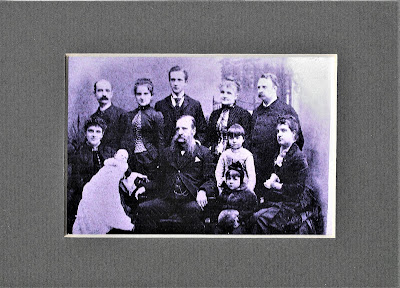
Family Photo of William Frederick Poole.

February 4, 1882 lasted two days for my gg-grandfather, William Frederick Poole, as this is how long it took him to fill out a New England Historic Genealogical Society (NEHGS) application inviting him to be a corresponding member of the society. In their four required pages, he wrote about his life's work, including listing 17 published works (with full titles and dates), and gave six generations of his ancestors "in direct line, as far as is convenient to do" from his father who was born in 1763 to his 5th great grandfather, John Poole who died in 1667 in Reading, Massachusetts. Why didn't I find this 25 years ago?

When I began my genealogy hobby in 1989, I naturally started with my parents as I knew my father was born in Illinois. A few years later and generations too, the Pooles were born and living in Illinois. It wasn't until January 1998 at the NEHGS (in Boston) I discovered his huge obituary in the New York Times and learned he was born in Salem, MA. This is the very best thing a genealogist could wish for, learning this ancestor's roots were nearby. The very next day I drove to Harmony Grove Cemetery in Salem. MA where he and his parents were buried.

One of the strangest things was I wasn't looking for anything on him because a month previously sent the last of my Poole information to a first cousin. However as luck would have it, with a few minutes on the AmericanAncestor's web page, I put in his name with his birth date and the word Evanston, Ill. The first thing that appeared was a total surprise. Fortunately, this Society kept and scanned all their applications, and this one was dated 1883. You might consider using this source. I just read "This database contains over 11,000 pages of applications and correspondence and 121,000 searchable names."

With my ancestor living near Chicago, I would never have thought his information would pop up in Boston!

Below are three sections:


I found this information on the American Ancestors (NEHGS) site at:
https://www.americanancestors.org/
The citation and all pertinent information are below.


"Citation

NEHGS Membership Applications, 1845-1900. (Online database. AmericanAncestors.org, New England Historic Genealogical Society, 2020.)

https://www.americanancestors.org/DB2758/rd/58871/33-co1/1427893480

Description

American Ancestors and New England Historic Genealogical Society (NEHGS) is America’s founding genealogical organization and the most respected name in family history. Since its founding in 1845, NEHGS has had a written membership process that typically includes written biographical and genealogical information about each new member. As part of the 175th anniversary of its founding, American Ancestors has indexed the membership application forms and correspondence for those who joined between the years 1845 and 1900. The first member was former President John Quincy Adams, and the database contains membership information for several other Presidents and other famous individuals.

The 52 volumes in this database are organized by the year that the member joined NEHGS. The records indexed in this database are generally between the years 1620 to 1900, though some will be found outside this range. The most common record types are Birth, Baptism, Marriage, and Death. There are also many Residence records, as they include where the member lived when they joined NEHGS. This database contains over 11,000 pages of applications and correspondence and 121,000 searchable names.

Please be aware that the genealogical information submitted with these applications was not reviewed or verified for accuracy.

Keywords: AAUnique"


Tuesday, May 18, 2021

Wakefield Old Burying Ground, Wakefield, Massachusetts

The Wakefield Old Burying Ground is beside Lake Quannapowitt in Wakefield, Massachusetts. (There is nice information about this cemetery posted on FindAGrave, see the end of this post.) My last visit was in 2000 to find my ancestor's tombstone. On this recent May 2nd beautiful spring day, everybody was out walking and enjoying the day. Fortunately, I didn't have to look too long before I found two stones I was looking for. My Ancestor's stone was easy to spot, five others were not. A list of those relatives is listed below. FindAGrave has photos, even with pictures, I couldn't find them in person.

"The gravestones in this semi-circle were originally located in the town's first Burying Ground, near the present site of the Bandstand.
These stones represent some of the oldest expressions of Puritan gravestone art in New England."

Another sign provides this information.

"The earliest settlers in this town were Puritans from Lynn, who began making their home here in 1639. The slate gravestones in the Old Burying Ground represent our truest link with those first settlers.

The first stone in this line is that of my 9th great-grandfather, Jonathan Poole. The second photo shows his footstone.

Jonathan Poole
Born: Abt. 1634, Middlesex Co., Massachusetts
Died: December 24, 1678, Reading (now Wakefield), Middlesex Co., Massachusetts

Jonathan Poole married Judith Jacobs
They were my 9th great-grandparents.

See my post of March 23, 2010 showing a little sharper image of my photo taken in 2000.

When I saw this Wheelock family stone broken and on the ground, I took an interest because I have the Wheelock and Newhall surnames. I believe this was the first time I purposely took a photo of an upsidedown stone. Why? Because I finally realized I could rotate the photo at home. Why didn't I figure that out years ago?

Delorma B. Wheelock
1818  --  1896

Mary S. Newhall
His Wife.
1824  --  1900

Albert A. Wheelock, M. D.
1866  --  1949


(My 8th great-granduncle was located, as was his wife.)

Here Lyes Buried
ye Body of Deacon
Thomas Nickols
Who Haveing Served ye?
Church of Christ in
Reading 25, Years Departed
this life Febr 9th 1736 in
ye 82nd Year of His Age.

Here lyes Buried ye
Body of Mrs. Rebecka (Eaton)
Nickols Wife to Deacon
Thomas Nickols
Who Died October
17th 1732 in her? 68th
Year of her Age.
ye Memory of ye Just is Blessed


I couldn't these stones, but they are posted on FindAGrave:
Capt. Thomas Poole died Dec. 26, 1732 (8th great-grand uncle)
Thomas Wiley died Feb. 16, 1780 (7th great-grand uncle)
Benjamin Pool died Dec. 17, 1732 (5th great-grand uncle)
John Nickols, Sr. died Dec. 16, 1721 (8th great-grand uncle)
Benjamin Fitch died March 12, 1712 (7th great-grandfather)

The cemetery is beside the bank of Lake Quannapowitt.


Old Burying Ground

Also known as First Congregational Churchyard

LOCATION
Church Street
Wakefield, Middlesex County, Massachusetts, 01880 USA  
PHONE781-246-6300
WEBSITE
MEMORIALS971 added (62% photographed)
CEMETERY ID91376

This is actually the second burial ground of the First parish church. The first was further east in what is now the park about where the bandstand is located. Its stones were moved to this burial ground when it was begun around 1688-9. It was the main burial ground for the town for about 150 years. It contains the graves of many of the towns early settlers and early families including Rev. Richard Brown (1732), Rev. Mr. Wm. Hobby (1765) and Rev. Caleb Prentiss (1803) all of whom served the First Parish.

In 1846 the burial ground was recognized as being too small for the growing town and a number of citizens formed the Lakeside Cemetery as a private cemetery further north and west on Lake Quannapowitt.

There are approximately 600 headstones. The earliest death date is 1681, the latest 1926.

The Massachusetts Historical Commission refers to this cemetery in MACRIS as WAK.801 Old Burial Ground.

This cemetery is referred to as GR1 Old Cemetery, formerly Town Burying Ground in the "Vital Records of Wakefield Massachusetts to the end of the year 1849."

From the town of Wakefield website:

How do I find information about family plots, lot location, or genealogy?

Cemetery records are available in the Public Works office at Town Hall, located at 1 Lafayette Street.

Phone:
(781) 246-6301 x 4
Address:
Town Hall
1 Lafayette Street
Wakefield, MA 01880

Thursday, January 29, 2015

His Little Green Book Was So Organized, Why Can't I Be?

Since 1981 this little green book has been looked at many times because it contained a wealth of information about my Grandfather's many trips. At the time of his death, this was one of several things I decided to keep. It was in good condition, but I looked at it so many times that page holes had torn and the binding had to be taped.

When my grandfather married in 1953 to his secretary three months after his wife passed away, I believe they decided to spend their time together (he was 61, she 52) traveling around the world. There is no date on this book, but the fact that they went to Cuba is an indication it was before 1962, and Cuba is #1 in the index and first page, shown below. I believe their honeymoon was in Cuba and Mexico.

Many years later, I received over 2,500 slides that corresponded to the pages in this book. I had seen many of the slides when they shared them with my family during our infrequent visits to Connecticut. They not only traveled the world, but spent winters in Florida, and summers in England. Some of you might remember the hand-made Christmas cards he made when I posted them to my blog.

I believe I inherited my love of travel, genealogy, and photography through him, but not the ability to be organized. He was a NYC architect, so that accounts for his neatness and organizational skills, I believe. Many years later, when the widow was moving, she wanted to get rid of the slides, all in trays, in about 10 Xerox paper boxes. Nobody wanted them, but I did express an interest. Ultimately, I got them, and they remained in my basement for about 15 years...never looked at them, so they collected mold.

I know, that's sad and I should have known better. My grandfather would be horrified with me, especially if he knew I had to toss after I went through each slide. I kept maybe 10. To clarify a bit, all slides with family members had been kept by the widow, and I have no idea why this index book wasn't with the slides. I assume she knew about it.

Regretting isn't going to help me now. I can hear my genealogy friends' voices now, and believe me, I don't know what I was thinking. But a lesson to those who have old photos and slides, don't keep them in the basement.

Since this is the beginning of a new year, I'm going to try very hard to be more organized in my life. Not just with genealogy, but with personal papers as well. Actually, I am going to put the person before the genealogy as we move into February. He'll be watching me, and telling me to go quicker so I can get back to genealogy!

The index (top and bottom) consisted of two pages. You can see for Cuba and Mexico there are two pages,  some countries had many pages.


 There are 5 pages on the ships list.

These are a few of the slides that I kept.


Friday, January 3, 2014

Do You Have Any of These Cemeteries for Your Ancestors? See Where 148 of mine are Buried.


Many years before beginning my blog in 2009, I did my best at keeping records for myself, never thinking I would be sharing them to others. However, the other day, while reading many Facebook friend's New Year's resolutions, some blogs and and general ideas about how to get organized, clicked. One friend mentioned doing a list of gravestones.

I began visiting many cemeteries in 1999, 2000 and 2001. A lot changed after 9/11, and I didn't travel as much. My list remained dormant for about 9 years, until I began blogging. You can see, that my list had 121 listings for my direct ancestors only. The various columns are: their relationship to me, cemetery name, location, date of death, date visited and age at death. An additional column lists either a M or F for mothers or fathers side. In the past over 4 years, I've visited quite a few cemeteries and only took 21 photos, so you can see, blogging had little, if any affect on my list.

My problem now is to relearn Excel, because I can't remember how to change the listing to show it alphabetical, or any of the other categories. I didn't even know I had Excel, as my original list was in Access on a XP. Also, I have to learn how to use Microsoft Office with my Win. 8 laptop, and to get the below Vista listing into the new computer. Technology can be a problem for somebody of the "silent" generation.

My next steps are:

1. Double check to be sure all 146 are on Find-A-Grave.
2. Learn how to use Microsoft Office 2013 and Excel.
3. Take additional photos of where other ancestors are, mostly in Connecticut.

For you to take away, one of my best hints is, if a stone is on Find-A-Grave, always make a photo of it and take it with you. This has helped me many times.


Thursday, February 28, 2013

Colorful Indexes Were My Lazy Man's Way to Research

Before any of the census images were online, you had to go to a National Archives and Records Administration (NARA) location, either in Washington, DC or one of the several branches throughout the United States, to see the censuses. Then to locate your particular film, you could borrow or purchase a census booklet, Population Census Schedule, for the census year you were searching... this method really felt like researching. It was far more time-consuming, yet more rewarding than typing in a name on Ancestry. (Note: the first census had 12 rolls, the 4th census had 142 rolls.)

There was a second way to see what was in a census. It was my lazy man's way, but not everybody could do this. You had to have access to the census books. Fortunately, there was a collection of them at the NARA Boston (Waltham) branch, where all the census rolls were also located. However, the New England Historic Genealogical Society Library (NEHGS) has a much larger collection of books (shown in photos), because they didn't have all the census rolls for the entire United States, as the NARA did. NEHGS made up for the absence of census film rolls by providing these books. The books begin with the first census, 1790 and many ended many years later when the books got too large to continue.

I discovered early on my lazy man's way of research. If I was working on somebody listed in the 1870 census book, I'd quickly look him up in the 1860, then 1850 and so forth. Naturally they weren't always in the same town or state, but for the most part I was able to find many people. Below are several of the books, then an example of the 1790 for Connecticut, which I used many times. The listing appears to go in order of the census taker's visits, so you can see easily the FANs (Friends Associates and Neighbors). However, some census books were done alphabetical (see example).
Connecticut and New Hampshire, New York (above and below).

Texas, Utah and Vermont above.
Census lists show order of visits and alphabetical.

  The 1860 Mortality book for Connecticut (listing of deceased below).


Tuesday, January 29, 2013

Constantly Surprising Me, From California to Massachusetts

Signature of  Charles H. Poole
See enlarged below.
Half of my information about my great-great-grandfather was found the usual way...I found vital records, city directories, the cemetery stone, will, and probate records. I didn't find his entire life history online, but pretty much everything I needed, except where he was married on March 26, 1850. Charles H. Poole with his facts of life, now surprises me in three ways.

The first amazing thing was my discovery eight years ago of the family genealogy manuscript he wrote, now located at the New England Historic Genealogical Society (NEHGS) in Boston. Because it is 257 fragile legal-sized pages, I wasn't allowed to copy it. Two weeks ago, I began taking photos with my iPad and sending pages to a cousin who offered to type them. Fortunately, the manuscript is typewritten, which makes it easy to read, and comes complete with a huge genealogy and transcripts of wills and deeds.

Second, I was rather excited upon learning that he surveyed parts of San Diego, California. A Google search brought up The History of San Diego, which said about him, "An engineer, Charles H. Poole, was hired and he surveyed a 200-mile railroad route to Yuma that followed the bed of the San Diego River, climbing 1087 feet gradually in thirty-nine miles through Mission Gorge, Santee, Lakeside, and Capitan Gorge and northeast through the steep-walled canyon to the base of Eagle Peak. From there the grade became increasingly steep for the next seven and a half miles, climbing 1255 feet out of the can­yon to the floor of Santa Ysabel Valley, near where Coleman Creek flows into the San Diego River. The last mile and a half from the canyon to the southern edge of the valley floor was to be a climb of 452.7 feet per mile through what Poole called Santa Ysabel Gulch. But the grade was more than 8.5 percent, virtually impassable. From Santa Ysabel, the route was to follow the wagon route to Warner's and down San Felipe Pass. Other surveys were to be made and many arguments advanced, and the hopes of San Diego lingered on until buried by the Civil War."  I also learned he was the Surveyor for San Diego County, then for other areas in California, and wrote with several others, a book, Reports of Explorations and Surveys, To Ascertain the Most Practicable and Economic Route for a Railroad from the Mississippi River to the Pacific Ocean. Made Under the Direction of the Secretary of War, In 1853-6, According to Acts of Congress of March 3" by Parke, John G.; Albert H. Campbell and Charles H. Poole.

Third, I now learn he is back in Massachusetts, near where he was born, about 34 miles from me. This was my huge surprise last week. For somebody who had children born in San Diego, northern California, and Mobile, Alabama, I now find him in Roxbury, Massachusetts, per the city directory for 1852! Still in Roxbury in 1856, he drew a "Foldout map of City of Roxbury (Boston), 1856: by Charles H. Poole, engraved by E.A. Teulon. The book contains many pages of advertisements in the front section, along with lunar tables, a calendar, a fold-out map, and a city directory with Last name, First name, and street address location." See Northwest Press Books for a photo of the directory, description, and sale price. The dealer just gave me permission to show the book, so thanks to Eric Brown. (See Below.)

"Charles H. Poole was born in Salem, Massachusetts, in 1825, and while receiving his education at West Point, became a civil engineer and passed his entire life in the service of the United States government. His duties called him much of the time to Washington, D. C, where he passed away in the year 1880. His wife bore the maiden name of Mary A. Daniels and they were residents of Benicia, California, at the time of the birth of Charles Clarence Poole on the 27th of November, 1856." This short bio was from Chicago: its history and its builders, a century of marvelous growth, Volume 5  By Josiah Seymour Currey.

If I had not done Google searches on his name, I would not have known about his surveying career, nor known that he was sent to Massachusetts for a short period, before settling long-term at the Interior Dept. in Washington, D.C., where he worked and died. So, don't stop with the basic information, but dig deeper, and use combinations of keywords on Google.

Two mysteries are now solved because of what I discovered about him last week. First, he did maps, okay that was new to me, and it is probably why my father had a large map collection. Some were framed, and most were flat in a map drawer. Dad must have inherited them, and I've got one hanging on my wall. Second, I believe he began the Poole manuscript while he was working in the Boston area (Roxbury), and I wouldn't be surprised if he wasn't one of the earliest members of NEHGS, he had ties with the Society, his death notice was in the Register and he made sure his manuscript was donated there.


Tuesday, January 24, 2012

Can't Read a Will? -- Tuesday's Tip

Have you ever tried to read a will, either an old one or a more recent one? Since I've been blogging, I've transcribed at least 10, and have had problems with reading the handwriting on all of them. The other day, while typing up my most recent for the post for yesterday, I discovered a way to figure out what some of the words were. I don't believe I've ever seen this method before. Being a huge user of Google, I decided to type in some key words, both before my unknown word/s and some key words after the unknown. Below, I give two examples of what I was up against, and Google helped!


I used these Key Words: lastly as to all the rest residue ___ whether real or personal (I knew I was missing about four words).
Correct: All the rest, residue and remainder of my estate, whether real, personal.


I used these Key Words: Decease her ____  apparel is to be given to my
Correct:  Decease her wearing apparel is to be given to my

Tuesday, July 12, 2011

Tombstone Tuesday -- What Would You Do?

My June 7, 2011 post was a request for help. I'd love to have somebody take a photo of my grandparent's graves. This came about because I went through some old correspondence with the cemetery, dated 1998 and 1999. The thought came to my mind, what if I hadn't written the letter, what if I had used email instead and didn't print out the reply. A few what if's, but I'm thinking that is what is happening these days. No hard copies anywhere, and surely none coming in the mail.

Below are two sections of a letter Memorial Park Cemetery sent to me. The first section tells me that William Frederick Poole and Charles Poole are not buried there. When I received that, it was an eye opener and within a few weeks, I discovered where they were. William is buried just 35 miles from me, and  Charles is buried in Washington, DC. Both died in Illinois. It is important to not assume where they died, if you don't know for sure.

Then I was informed there were two spaces available in the plot of my grandparents. Both of their children are deceased (my aunt and father), and there are now six grandchildren. Perhaps I read that 12 or so years ago, but I was probably more intent in finding where William and Charles were buried. Now, reading it again, I'm wondering what to do. Perhaps try to contact some of the cousins, we all live in different states, but until I get the addresses, I'll write the cemetery and put in writing that it is my desire to donate the plot.

The letter below proves it is necessary to contact cemeteries when looking for a more recent ancestor's burial. You never know what they have in their files. (I enlarged the print so you could read it easily.)


----------------------

Monday, June 27, 2011

Hint for Taking Cemetery Photos

If you see a stone on Find-A-Grave and want to locate it in a cemetery, print a copy to take with you. If you are lucky, the photographer took both a close-up and one from about 10 feet away. A wide shot gives you more of an idea where she or he found it in that cemetery. With your printed copy, you can see what the shape of the stone is, don't rely on your memory, if you are looking for a lot of them.


Be sure to check and see if the FindAGrave site has additional photos not shown on the home page, which has a limit of three. My second photo clearly gives you an idea of where this stone is.


Solomon Glezen (also spelled Gleason)
Born:  March 14, 1734, Worcester, Worcester Co., Massachusetts
Died:  August 10, 1810, Lenox, Berkshire Co., Massachusetts
and his wife
Lydia Whittelsey
Born:  September 10, 1739, Wethersfield, Hartford Co., Massachusetts
Died: September 6, 1810, Lenox, Berkshire Co., Massachusetts

They are my 5th great-grandparents.

They died within a month of each other and are buried, along with their son, Amasa Glezen, who died in 1808.
Lenox, Berkshire Co., Massachusetts

Sunday, March 6, 2011

The Best Blog Hints


There are 1778 genealogy blogs on Tom MacEntee's GeneaBlogger list as of March 5, 2011! When I began blogging, in October 2009, there were about 700. What a lot of people blogging about genealogy or history. And why do some blogs get a lot of traffic and others don't, yet they are both writing pretty much about the same thing? Maybe some of the hints from my previous post or the ones from below might help you, and you don't have to blog about genealogy, they would apply to any topic.


On February 20th I posted The Best Blog Hints. These were not my ideas but were taken from various sources, but I picked the ones I liked and tried to follow. Quite a few readers made comments with additional ideas, you might enjoy some of them.


Stories are More Important than Sales


Ask for Comments


Be Original in Content


Be personal, but not too Personal


Determine the Goal of your About Page

Every day, I receive an email from ProBlogger with Blog Tips (ProBlogger.net), I've been a subscriber for over a year and the posts are written by bloggers. The best thing is, I usually know what they are talking about.


Today's blog was titled 7 Good Things that Blogging Brings. It was so good, that I felt this was the perfect time to post my Part 2. The newsletter is FREE, it is always informative and fun to read.

A few other good hints about blogging:


Plan the Blog; Blog the Plan


How to Create a Successful Blog (additional hints from this YouTube video)