Pages

The Life From The Roots blog topics have changed several times since I began this blog in 2009. I initially wrote only about the family history I had been working on for 20 years. Years later, I was into visiting gardens, historical homes, churches, libraries that had genealogical collections, historical societies, war memorials, and travel/tourism places. I also enjoy posting autographs and photos of famous people I've met or have seen.

Along with my New England roots, other areas include New York, New Jersey, Michigan, Illinois, Wisconsin, and the Eastern Townships of Quebec, Canada.

Please check out the labels on the right side for topics (please note, they need work). Below the labels and pageviews is a listing of my top nine posts, according to Google. Four of them pertain to Lowell, MA. These posts change often because they are based on what people are reading.
Showing posts with label Location: Illinois. Show all posts

Saturday, January 6, 2024

I Recently Received Photos of My Poole Grandparents, They Loved Cats


Clarence F. Poole   1891-1957
Photo dated 1940

Marjorie Adams Poole   1891-1953
Photo dated 1940

Photo of their house taken about 1935.

(Google Nov. 22, 2023)
Grandparents lived here 30 years.

Both of these pictures are of my grandmother holding my father in 1919.

Wednesday, March 15, 2023

Wow is All I can say, Imagine Finding Clues this Way

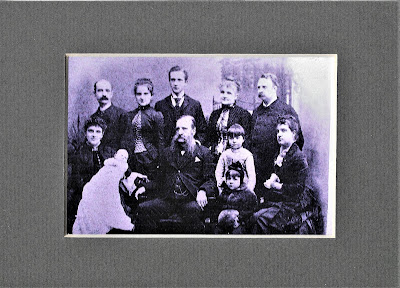
Family Photo of William Frederick Poole.

February 4, 1882 lasted two days for my gg-grandfather, William Frederick Poole, as this is how long it took him to fill out a New England Historic Genealogical Society (NEHGS) application inviting him to be a corresponding member of the society. In their four required pages, he wrote about his life's work, including listing 17 published works (with full titles and dates), and gave six generations of his ancestors "in direct line, as far as is convenient to do" from his father who was born in 1763 to his 5th great grandfather, John Poole who died in 1667 in Reading, Massachusetts. Why didn't I find this 25 years ago?

When I began my genealogy hobby in 1989, I naturally started with my parents as I knew my father was born in Illinois. A few years later and generations too, the Pooles were born and living in Illinois. It wasn't until January 1998 at the NEHGS (in Boston) I discovered his huge obituary in the New York Times and learned he was born in Salem, MA. This is the very best thing a genealogist could wish for, learning this ancestor's roots were nearby. The very next day I drove to Harmony Grove Cemetery in Salem. MA where he and his parents were buried.

One of the strangest things was I wasn't looking for anything on him because a month previously sent the last of my Poole information to a first cousin. However as luck would have it, with a few minutes on the AmericanAncestor's web page, I put in his name with his birth date and the word Evanston, Ill. The first thing that appeared was a total surprise. Fortunately, this Society kept and scanned all their applications, and this one was dated 1883. You might consider using this source. I just read "This database contains over 11,000 pages of applications and correspondence and 121,000 searchable names."

With my ancestor living near Chicago, I would never have thought his information would pop up in Boston!

Below are three sections:


I found this information on the American Ancestors (NEHGS) site at:
https://www.americanancestors.org/
The citation and all pertinent information are below.


"Citation

NEHGS Membership Applications, 1845-1900. (Online database. AmericanAncestors.org, New England Historic Genealogical Society, 2020.)

https://www.americanancestors.org/DB2758/rd/58871/33-co1/1427893480

Description

American Ancestors and New England Historic Genealogical Society (NEHGS) is America’s founding genealogical organization and the most respected name in family history. Since its founding in 1845, NEHGS has had a written membership process that typically includes written biographical and genealogical information about each new member. As part of the 175th anniversary of its founding, American Ancestors has indexed the membership application forms and correspondence for those who joined between the years 1845 and 1900. The first member was former President John Quincy Adams, and the database contains membership information for several other Presidents and other famous individuals.

The 52 volumes in this database are organized by the year that the member joined NEHGS. The records indexed in this database are generally between the years 1620 to 1900, though some will be found outside this range. The most common record types are Birth, Baptism, Marriage, and Death. There are also many Residence records, as they include where the member lived when they joined NEHGS. This database contains over 11,000 pages of applications and correspondence and 121,000 searchable names.

Please be aware that the genealogical information submitted with these applications was not reviewed or verified for accuracy.

Keywords: AAUnique"


Tuesday, March 5, 2019

Nurse Frances and the Flu


For many years, I always knew the year my grandaunt, Frances Poole (born  27 Oct 1886) died, but I didn't have the date, location or cause of death. Imagine my surprise when at long last, I began researching her life and trying to find out why she died so young.

Suddenly, this 32 year old became alive, instead of just a name with death date of 1918. I found out she was a nurse. What a brave young woman to travel from the Chicago area to New York state to help the sick. She came from a rather wealthy family, was single and probably had all the wants and needs of her day. Her father, a patent attorney had died four years earlier and left her a house and the lands at 1015 Forest Avenue, Evanston, Illinois. She was the oldest of four children, although the paper only named two. Her maternal grandfather was William Frederick Poole, the head librarian at the Newberry Library in Chicago, who died two years before her birth. She was among the first to die in New York of the influenza.  Frances Poole died October 8, 1918. Of all those deaths, and my Frances was the one most important to me. I am saddened by how it happened, but I am so proud of her, a young woman trying to help the sick, trying to make a difference. I wish I knew more about her, but what I know, I won't ever forget.


All my sources came from newspapers and printed articles. I haven't located her death record yet.

From the Chicago Daily Tribune. Oct 11, 1918 - "Miss Frances Poole, Red Cross, from Evanston was buried yesterday in Rock Creek Cemetery, Washington D.C. Miss Poole daughter of Mrs Charles Clarence Poole, 1123 Maple Avenue, Evanston died Tuesday at Camp Ontario, Oswego, NY of pneumonia following Influenza."

From the Chicago Daily Tribune. Oct. 27, 1918, Pg. 15 was the following Death Notice:
"Poole - Memorial services will be held for Frances Poole, army nurse, daughter of Mrs. C. Clarence Poole, sister of Lieut. Charles H. Poole, A. E. F.; and Dorothy Poole, at St. Luke's Episcopal church, Hinman and Lee Sts., Evanston, Ill., at 4:30 o'clock Sunday afternoon, Oct. 27th."

From the Ontario Post, October 26, 1918, page 2 is the obituary of two nurses, Ida Ferguson and my Frances who was listed as Frances Pool, Poole. What is interesting is, I just learned that her mother, Anna Poole was with her daughter when she died. Anna traveled from Evanston, Illinois to Camp Ontario, Oswego, NY. Thanks to Mary Kay Stone from the Oswego County Historical Society.

I believe the photo below shows one of the first groups of nurses who arrived at Oswego, New York to attend the sick soldiers. I have a feeling that my relative is in this photo, as she died 8  October 1918.
Nurses at Fort Ontario, Oswego, NY, c. 1918.
 Permission was granted to use photo by the Oswego County Historical Society. (8/2019)


From: Bell Telephone News 

 - Volume 8 - Page 52
[graphic][merged small][ocr errors]
Frances Poole
"One star has turned to gold on the service flag of the Chicago traffic department. It is the star of a girl who has given her life in the service of others.
"Miss Frances Poole came to the telephone company on August 14, 1916, as a nurse in the welfare department. She made many friends among the girls in her visits to the sick and later, through her position as nurse at Margaret Mackin Hall where she lived for a year and a half, had an opportunity to become a close and intimate friend of hundreds of girls who were there at different times. It was while she was at Margaret Mackin Hall that she decided to offer her services to the Red Cross. She was not able physically to stand the test for overseas service; but was placed on the list for work in this country. While awaiting her call she filled the place of Miss Julia Goodman, who left the Oakland district for overseas Red Cross service. She made many friends among the girls in the South Side offices, and it was with regret that her resignation was accepted when the call came for service at Camp Ontario, Oswego, N. Y.
During the terrible epidemic which was very severe in Camp Ontario, Miss Poole did not spare herself and, though she had a severe cold and was urged not to go on duty, she saw the extreme need of the boys, and, like a brave soldier, fought the fight until she fell— a victim of pneumonia. Her mother reached her two hours before her death, bringing by her presence the greatest joy to her daughter that she could have had at the last.
Mrs. Poole has the sympathy of hosts of friends. She has given much for her country; two sons are in the service— Lieut. Charles H. Poole with the coast artillery 'Over There,' and Lieut. Clarence T. Poole with the Quartermaster Corps in Washington.
Miss Poole had an unusually sunny disposition and a friendly spirit which made her dear even to those who knew her only for a short time. She was "one of the girls," a good comrade giving not only advice which she, through her nurse's training could give so well, but giving herself. "Sunshiny Frances" was her mother's name for her and we can imagine that our golden star is more golden because it shines with the glory of a lovely character. Such stars are not lost but shine on with a steady radiance inspiring us all to give our best.
Miss Poole was buried at Rock Creek Cemetery, Washington, D. C, where her father was buried some time ago."

From: Daily Northwestern, Evanston, Illinois, Friday, April 5, 1918, Page 1.
"Star Honors Heroes  --
"At Chapel this morning President Holgate will present to the University a huge service flag in honor of the Northwestern men in National service. Mr. Marsh is in charge of the program, which besides special music will include a speech by Nancy Knight who will tell of Women's War work in Evanston.

The flag was purchased by Elizabeth Ambuhl. Lucy Harrison and Marian Goodsmith helped her sew on the figure 1120, their service taking them back to the good old days of Betsy Ross. 1119 Northwestern men have gone in the service, and Frances Poole is going with the Presbyterian Hospital Unite, makes up the number. The blue star stands for the living and the gold star for the dead.

Four of our soldiers have already given their lives for their country. They are: Captain Robert Tracy Gillmore, Med. '92. Died at Ft. Oglethorpe, Ga., Jan. 20, 1918. Frank L. Seery, Arts-Ex- '18. Killed in airplane collision, Kekky Field, Texas, Jan. 21, 1918. Earl C. Adams, Arts, Ex-'19. Died at Ft. Sill, Okla., Feb. 3, 1918. G. W. Morton, Law. '16. Died at Camp Grand, Rockford, Ill. Feb. 2."

From:The Syllabus (Northwestern University),Volume XXXV, pg. 130.
Students Publishing Company, 1920  (Note: The link is no longer active.)
"To Frances Poole, the only woman among the Northwestern students who victoriously gave their lives in service, the University pays double homage. A resident of Evanston, a graduate of the high school, an active worker in St. Luke's church, and a popular member of the class of 1911, she was known and loved by many friends. She left the University in her junior year, entered a nurses training course and graduated from the Presbyterian hospital in 1915. Choosing the branch of work in which she could be of service to the greatest number, she refused to enter private duty and became welfare nurse at the Chicago Telephone Company's home in Warrenville where the operators go for rest. Later she was assigned by the Company to do home visiting in a district on the south side.

She was peculiarly fitted for the nursing profession because of the wonderfully joyous spirit with which she was endowed. Hers was a contagious cheeriness which carried her triumphantly through the most uninspiring tasks and difficult places. When the call came from the Red Cross for nurses, she enlisted, as all who knew her best expected she would do, and was assigned on August 1, to the General Hospital at Fort Ontario, Oswego, N.Y. As she had been a comfort and inspiration to the telephone girls under £ care, so she brought to bear upon her new tasks not only her technical skill but her courageously joyous spirit. 'What is the use of fighting,' she said, “if one cannot fight with a smile?

The last week in September when the influenza epidemic was at its worst, her patients were on an open porch exposed to a biting wind from off the lake. Except for two hours rest, she worked from four in the morning to seven at night, and often gave assistance to the night nurses after that. Because of weariness and exposure she contracted the influenza but refused to go off duty. Wearing a mask constantly, she remained for a week caring for the boys who needed her. Pneumonia set in and in five days she quietly slipped away. She had wanted to come home with colors flying and so she did."

From: Evanston History Center (Illinois) I found a full page about Frances (partial below).
"After graduating from Evanston Township High School, Frances entered Northwestern University. She left in 1911 in order to enroll in a nurse training program at the Presbyterian Hospital. She graduated from the program in 1915 and elected to become a “welfare nurse” to help those in need. First she worked for the Chicago Telephone Company’s home in Warrenville, IL. Later, she worked for the same company on the South Side of Chicago, making home visits to patients.

Once the United States entered the Great War, her two brothers Clarence and Charles, both entered the service. Frances wanted to do her 'bit' too. She responded to the American Red Cross’ recruiting call. Nurses were desperately needed and Frances decided that she could take her skills as a nurse and apply them in service to her country. She was assigned to the military hospital (General Hospital No. 5) at Fort Ontario in Oswego, NY. The busy hospital staff cared for sick or wounded U.S. troops who had been brought back home from France.


At the time, to work in a hospital was nearly as dangerous as being near the front lines. In 1918, it became even more dangerous upon the outbreak of an international influenza pandemic, brought on by the global movement of people at war."


From two official records  records about the The Great Pandemic of 1918-1919 in the United States:

"First Official Report of Influenza: The Public Health Service did not require states to report influenza before September 27th. New York first reported the presence of influenza on September 27th, but the disease was undoubtedly present in the state before that date.
On October 11th, the PHS said that 'Epidemics have been reported from Maybrook town (Orange County), Montgomery (Orange County), North Tonawanda, and Oswego. School and theaters had not been closed.' By October 18th, state officials admitted that influenza was prevalent throughout the state.

Although state authorities were too overwhelmed by the pandemic to keep accurate records, they did attempt to record deaths. By late October, New York City, Albany, Buffalo, Schenectady and Syracuse reported elevated death rates. During the week of November 1st, the PHS reported a total of 12,357 deaths in New York City. For the previous six weeks a total of 30,736 deaths were reported. The actual number of influenza-related deaths during this period was probably much higher."
"In October of 1918, Congress approved a $1 million budget for the U. S. Public Health Service to recruit 1000 medical doctors and over 700 registered nurses. Nurses were scarce, as their proximity to and interaction with the disease increased the risk of death." Frances may have been one of the nurses who answered this call."
"The flu afflicted over 25 percent of the U.S. population. In one year, the average life expectancy in the United States dropped by 12 years."


Frances and her parents buried at Rock Creek Cemetery, Washington, D.C.
1015 Forest Avenue, Evanston, Illinois.
 This the house her father left to her in his will. The Redfin.com link for this address will show 26 beautiful photos of the house.

Monday, November 16, 2015

I Googled POEM and FITCH POOLE and came up with This


Every year I try to find an appropriate poem to use in Bill West's 7th annual Great Genealogy Poetry Challenge. I wanted my poem to have something to do with history or was written by an ancestor or family member. The easiest way to find information is to do a search by doing a google search. I simply typed in the search bar, "Poem" and "Fitch Poole," bingo twice. The first thing that caught my eye, was an article in Industrial Chicago: The Bench and Bar book about Charles Clarence Poole, my great-grandfather. The second piece of luck was finding a poem, to be posted Wednesday.

Below is the article google pushed in front of me, with the search words in red. The nicest surprise was seeing a photo and autograph of my great-grandfather. I hadn't seen it before!

Industrial Chicago: The Bench and Bar, Vol. VI
Chicago : The Goodspeed Publishing Company, 1896
pg. 210

"C. CLARENCE POOLE. Some details in the life and antecedents of this prominent patent attorney will be welcomed by all who have a real interest in the history of the bench and bar of Chicago. This city, the seat of many important manufactures, the center of large publishing interests, and in whose courts many celebrated cases arising from questions of ownership or violation of patents, trademarks and copyrights have been tried, has assumed an importance in such litigation second to that of no other manufacturing and commercial center in the country. Here there has grown up a class of patent lawyers as able as any in the world, one of the most reliable and most successful of whom is the gentleman to whose career these paragraphs are devoted.
pg. 211
     Of Puritan lineage, Mr. Poole is a son of Charles Henry and Mary A. (Daniels) Poole and was born at Benicia, Cal., November 27, 1856. His father, a civil engineer by profession, was at the time in the service of the United States Government at that point. His mother was the daughter of Stephen Daniels, Esq., of Salem, Mass.
     The founder of the family in America was John Poole of Reading, Mass., who came to the Massachusetts colony in 1632, was one of the first settlers of Cambridge, and was later granted land at Reading, and became one of the principal citizens of that place.
     Mr. Poole is a lineal descendant of Governor Dudley and Governor Bradstreet of the Massachusetts Colony, and is a descendant also of Manasseh Cutler of Hamilton, Mass., a scholar and statesman, who graduated at Yale College, studied law and was admitted to the bar; studied, also, medicine and divinity; was a chaplain in the American Army and a noted patriot in the Revolution; was a long pastor of the church at Hamilton; achieved distinction by researches in botany and other scientific investigations; was chosen a director of the Ohio Company in 1787 and was the leading spirit in opening the Northwest Territory to settlement and the planting of the first colony in Ohio; was largely instrumental in securing the passage of the 'Ordinance of 1787,' by which slavery was excluded from the Northwest Territory, and was a member of Congress from Massachusetts. The family from which Mr. Poole comes has, in nearly all its branches and all generations, been noted for its scholarly tastes. Fitch Poole who was known as the 'Danvers Poet,' was his uncle, and Dr. William Frederick Poole, the distinguished librarian, author of 'Poole's Index,' and authority on New England history, and until his recent lamented death librarian of the Newberry Library in this city, was his cousin.
     Mr. Poole early displayed a talent for mechanical studies, which he has since utilized in the practice of patent law, a department of legal work for which his abilities especially quality him. His early studies were in the schools of Washington, D. D., and later he was fitted for the practice of civil engineering by studies under private instructors, and in 1874 and 1875 served as assistant engineer in surveys carried on by the Engineer Department of the army. Among the records of the War Department are a set of maps and plans for a projected canal from Cumberland, Md., to Pittsburg, Pa., which were made by Mr. Poole from notes taken in the field before he was nineteen years old. Mr. Poole, also, by private instruction fitted himself for entering the higher classes of one of the principal Eastern universities, with a view of attending the same for a short time and taking a degree, but not being able to carry out this project, and intending to devote his attention to patent law, he entered the law school of the Columbian University at Washington, where he was graduated in 1882, taking a prize for an essay on 'Trademarks' at his graduation. In the fall of that year he came to Chicago, which he deemed to be a good field for the particular practice upon which he had determined to enter. He was first associated Melville F. Dayton, well known to the legal fraternity as a mechanical expert in court cases involving mechanical questions, in practice before the United States Patent Office, and later, also, in legal work, with Taylor E. Brown.
     Mr. Poole, during his practice of patent law, has acquired a high reputation for skill and ability, both in the work of procuring patents and in the conduct of patent litigation, and he has been employed as counsel in many important cases both in the Patent Office and in the courts. His field of effort has not been confined to Chicago, but he has been called upon to represent important interests in many suits brought in other parts of the country.
     Mr. Poole married, in 1884, at Chicago, Anne Poole, daughter of the late Dr. William Frederick Poole, librarian of the Newberry Library, and since his marriage has lived at Evanston.
pg. 212
     Mr. Poole is literary in his tastes, and is a member of the Chicago Literary Club, of which the late Professor David Swing was an interested and active member, and which includes among its membership the best among Chicago's able and scholarly men. He has contributed occasionally to the columns of newspapers and periodicals articles on various topics, and has also contributed to the literature of his profession papers on special subjects, some of which have been prepared for and published by the Patent Law Association, an organization which embraces among its members all lawyers of prominence in this branch of legal profession in Chicago. Moreover, Mr. Poole is now, and for some time past has been, engaged in the writing of a treatise or text book, soon to be published, treating exhaustively of the law relating to the validity of letters patent as affected by the application for the patent and proceedings in the Patent Office prior to the grant. This work Mr. Poole is especially qualified to prepare, by reason of his extended experience in the matters treated of, and it promises, according to the judgment of patent lawyers who know of its intended character and scope, to be one of the most valuable contributions yet made to the literature of this branch of the law."

pg. 373


Tuesday, October 20, 2015

There Were 27 Books About Witchcraft

In December 2013, I shared some parts of my 2nd great-grandfather's will in my post, Finally, What Was the Good Stuff in The Probate? I couldn't share his entire will and probate because it was 44 pages long. Three other posts were written about his will. Post #1, Post #2, Post #3.

The 4th post was written because I wanted to know what happened to the 2,600 books that were going to be sold. Specifically, I wondered if they went to a library.
A BILL OF APPRAISEMENT

of the Estate of William F. Poole, late of the County of Cook and State of Illinois, deceased.
                   One lot of Books (2,600 in number) at $1.00 per volume.
                                                                                      Total-         $2,600


Portrait of W.F. Poole
Newberry Library
Photo by Diane Boumenot
Being that William Frederick Poole was a well-known librarian, I thought his books would sell quickly. Thanks to a reader who contacted me in September, I now know how they were sold, and the titles of his 1,087 books, part of his 2,600 collection.

Ivy wrote, "I am a fellow at the Newberry library currently doing some research on Poole's Index, which is how I happened to come across your blog. I happened upon some biographical information in the Newberry Library archives regarding the sale of William Frederick Poole's books after his death. Yes, they were his personal collection, and it was quite extensive. The family tried to sell them privately, but it seems as if that didn't work out and so a public sale was held in 1900; there is a copy of the catalog of the sale in the Newberry's collection (Catalogue of the valuable private library of the late William F. Poole, LL.D., Librarian of the Newberry Library, Chicago, Ill.)" I was given the link and additional bits of information. 

She wrote again saying, "If you ever find yourself in the Chicago area, I would definitely suggest looking into those files, as his notes have information about family trees and other information (they're not super organized, though!). Williamson's (wrote biography of my ancestor) records do show that he tried to get in contact with family/descendants in the 1950s to see if they had letters or other records, but he did not turn up much." 

Then, I read: "I did happen to find that the sales catalog from Poole's book collection is also digitized on HathiTrust here, so you can see for yourself what books he had." http://hdl.handle.net/2027/mdp.39015020833938.

There were 76 pages of cataloged books! What were the topics? Well, the most surprising thing was seeing 27 books about witchcraft in his collection. If you would like to see the entire list, use the link above and scroll down to page 73. I'm sharing the description of two books on witchcraft, papers by Mr. Poole and his listing of the NEHGS Register (he was an early member to that society). The majority of his other books are about history.


Wednesday, April 23, 2014

Newberry Library, A Bust and Portrait of my Ancestor Taken by Diane Boumenot

I wrote about the Library in my post, "A Library, A Librarian and Two Cousins" three years ago this month, and have always wanted photos of the interior. My genealogy friend and blogger, Diane Boumenot who writes the blog, One Rhode Island Family mentioned she was going to go to the Newberry Library in Chicago if she had time during a conference. I asked if she did, could she take photos for me. She did a year ago, and I am just now posting them. Thank you, Diane.

My ancestor was the first Librarian at the Newberry, and Diane was aware of that. Below are a bust and portrait of him, William Frederick Poole.


The Library stands on the site
formerly occupied by the
Mahlon D. Ogden residence
the only house in the path of
the great fire of 1871
which was not burned.

Presented by the General Henry Dearborn Chapter
Daughters of the American Revolution
1929

Poole's Index of Periodical Literature was written by my 2nd great-grandfather.


Tuesday, December 17, 2013

Finally, What Was the Good Stuff in The Probate?


Etching of W. F. Poole
New York Times Obituary
A Bill of Appraisement of the Estate of William F. Poole, late of the County of Cook and State of Illinois, deceased was finally signed on 25 March 1895, a year after his death. The Will and Probate as well as the "The Longest Obituary I've Ever Seen" were discussed in previous posts, but I just have to share this with all the librarians who may have learned about him. Yes, he had assets, quite a lot in my opinion, but that isn't what interested me. I wanted to know if the Librarian of the Newberry Library in Chicago, Illinois had any books.

He sure did, 2,600 books, all valued at $1. That portion of his estate was worth $2,600. Why did he have so many books, did they belong to the library or were they actually his? And if they were his, was he going to give them away or donate to the Library. If they were his own, I wonder why didn't he just use the ones at the library and save his money.

Below are copies of the Bill of Appraisement, Agreement with Houghton, Mifflin and Co., and Appraisers' Estimate of the Value of Property Allowed to the Widow.


A BILL OF APPRAISEMENT

of the Estate of William F. Poole, late of the County of Cook and State of Illinois, deceased.
                   One lot of Books (2600 in number) at $1.00 per volume.
                                                                                      Total-         $2,600


             "Agreement between W. F. Poole and Houghton, Mifflin and Co. of Boston, Mass., dated September 30th, 1890, whereby Houghton/, Mifflin and Co. agree to pay royalty on all sales of 'Poole's Index to Periodical Literature.' The value of said contract is impossible to determine, but Houghten [sic], Mifflin and Company have paid to W. F. Poole from the time of the date of said contract, an average of $350.00 a year thereon."

Thursday, December 12, 2013

Scholars Do Him Homage and All 14 Wear Black Gloves

After I posted my December 1st post, Doctor, Medicine, Undertaker and Marshall Field Dress Bill, 1894,  Carol A. Bowen Stevens of Reflections from the Fence blog, wrote and inquired about the 16 pr. of black gloves that was listed on the Undertaker's bill of services. She mentioned perhaps I could find out if wearing black gloves was the custom in 1894. I did a few easy searches, because I happened to have the time, and got seriously interested in the search for information.

Then remembered my subscription to Fold3 that I get with my Connecticut Society of Genealogists subscription, which I had never used before. See post about my Fold3 subscription. My search words were: William Frederick Poole + pallbearers. It was so easy and wow, what results. A nice long report about his funeral and the names of all 14 honorary pallbearers.

The deceased was my 2nd great-grandfather, and the person of whom I wrote about in the Longest Obituary I've Ever Seen.

 From The Chicago Tribune, March 2, 1894, Page 8

 From The Chicago Tribune, March 4, 1894, Page 3

SCHOLARS DO HIM HOMAGE.

They Pay the Last Meed of Affection to
Librarian W. F. Poole.

     Funeral services for Dr. William F. Poole, librarian of the Newberry Library, were held yesterday afternoon at Evanston, where he had lived for many years. A short service of prayer and song was held at the family residence preliminary to the more formal rites held at the First Congregational Church at 3 o’clock. At that hour the large edifice was crowded, distinguished men from all ranks in life, professors from both the Northwestern and Chicago Universities, officials of both the Newberry and Chicago public libraries, as well as members of the many literary and cultured organizations with whom Dr. Poole had been associated, uniting to show their respect for him by their presence.
     At 3 o’clock the funeral procession entered the church to the strains of Beethoven’s funeral march. The honorary pallbearers preceded the casket. They were President Henry Wade Rogers of Northwestern University, Dr. Daniel Bonbright, President William R. Harper of Chicago University; H. J. Willing, trustee of the Newberry Library; Daniel L. Shorey and James L. High of the Chicago Literary club; Edward G. Mason, President of the Chicago Historical Society; Norman Williams, trustee of the Crerar Library; Emil G. Hirsch, President of the Board of Trustees of the Chicago Library; Librarian Frederick H. Hild; and Edward S. Isham, Franklin MacVeagh, George E. Adams, and John P. Wilson, the present Board of Trustees of the Newberry Library. Representatives of the Public Library Board who were present were: John G. Shortall, Pliny B. Smith, Bernhard Moos, and Secretary W. B. Wickersham. The active pallbearers were Charles Evans, Dr. Carl Pietssch, and Dr. G. F. Wire, assistants of Dr. Poole in the Newberry Library, and J. R. Patterson, W. A. Purer, and Reidar Arentz, who had formerly been assistants in the Chicago Public Library.
     The services were opened by the church choir with the hymn, “Beyond the Sighing and the Weeping.” Dr. J. F. Loba read the scripture funeral service and offered prayer. When “The Homeland” had been sun by the choir Dr. Loba said in part:
     “Every man lives a twofold life; one is that inner life of the heart with the aims and hopes, the sorrows and joys, the godward life which no one can see. The other is the manward life, the fruit, the product which the man gives to the world and on which his reputation rests. These two do not always coincide—sometimes lack much of it. But the perfect harmony of the two gives to the whole life the force of truth, harmony in the soul, and power to the work of man. The life of our dear friend was peculiarly great in the
Harmony between the ideal and the real. He was a great worker on the highest plane of human activities. He enriched the world of thought, he ruled in the realm of books, and like some great spirit he presided over the very source of human learning. In the midst of our sorrows and through our cares we may thank God for such a man.”
Dr. Franklin Fisk’s Tribute.
     Following Dr. Loba an address was given by Dr. Franklin Fisk, President of the Chicago Theological Seminary and a former classmate of Dr. Poole at Yale. He said:
     “The sorrowful event that has brought together this large congregation of friends to do honor to one who has for years occupied so large a place in our thoughts and in our esteem is to me peculiarly sad. Dr. Poole was my classmate at Yale. Our acquaintance, which began when we entered that ancient university in 1845, ripened long since into affectionate reward, and through nearly half a century has borne delightful fruitage. When he joined our class a few months after we entered college I well remember the marked impression he made. Although somewhat reserved in manner he had a genial nature and soon made many warm friends. He was old enough when he entered college to appreciate the value of a liberal education, and addressed himself to his studies in a manly way. But while faithful and successful in the studies of the college curriculum, he did not limit himself to them, but pushed his reading and study in all directions, especially in the domain of periodical literature. He early evinced a great love of books and revealed in libraries, and his love and knowledge of books led to his selection by ‘Brothers in Unity,’ a literary society in the college, as librarian of its library of some 12,000 volumes. In this capacity he early discovered a great need  of an indeed to general periodical literature—for the supply of which he even then, while yet a college student, addressed himself, and persisted in the great work with marvelous industry and energy through nearly half a century to the very close of his life. The development of his index from its inception is a genuine instance of evolution.

His Work for the Public Library.
     “In 1873 he was called to take charge of and to form the Public Library that had just then been organized amidst the ashes of Chicago. He fulfilled expectation. Under his supervision the Public Library of Chicago rapidly increased in well-selected volumes and in adaptation to public use till it became an equal of the foremost public libraries of our land. The eminence of Dr. Poole as a librarian led to his selection by the trustees of the Newberry Library fund when they sought for a competent person into whose hands to commit the great task of organizing and selecting a reference library that should stand through the ages; at once a monument to the generosity and foresight of its founder and a perpetual blessing to the millions who shall live in the great central city of the continent.
     “Of Dr. Poole’s personal characteristics as a man and a Christian I need not speak at length, for he lived among you many years. In heart he was a true believer in the Lord Jesus Christ and in life he tried faithfully to follow him. He was most highly esteemed and most loved by those who knew him best. This is a sad day for Evanston when two such eminent, honored, and beloved citizens as the Rev. Dr. Patterson and Dr. Poole and Dr. Poole are borne away to their burial. But though they will not again walk these beautiful streets and go in and out among you, yet the thought of what they were will abide with you and be a constant inspiration to noble living. Had Dr. Poole lived till next summer it was his purpose and my own to meet with our classmates at New Haven to celebrate the forty-fifth anniversary of our graduation from Yale. More than on-half of our class of nearly 100 have passed from earth, and now this dear classmate and friend has joined those who had gone before him. With a sore heart the ‘Farewell’ must be spoken in the sure hope of a blessed greeting at no distant day.”
     The services closed with the hymn “My Jesus as Thou Wilt,” by the choir. The remains were taken last evening to Salem, Mass., for interment.
     At a meeting of the members of the Newberry Library staff resolutions were unanimously adopted expressive of the esteem in which they held Dr. Poole.