Pages

The Life From The Roots blog topics have changed several times since I began this blog in 2009. I initially wrote only about the family history I had been working on for 20 years. Years later, I was into visiting gardens, historical homes, churches, libraries that had genealogical collections, historical societies, war memorials, and travel/tourism places. I also enjoy posting autographs and photos of famous people I've met or have seen.

Along with my New England roots, other areas include New York, New Jersey, Michigan, Illinois, Wisconsin, and the Eastern Townships of Quebec, Canada.

Please check out the labels on the right side for topics (please note, they need work). Below the labels and pageviews is a listing of my top nine posts, according to Google. Four of them pertain to Lowell, MA. These posts change often because they are based on what people are reading.

Friday, July 16, 2010

Lowrey Family Reunions -- One of Mine Started in 1875


In my file for this family, I noticed that Marjorie Lowrey, the Lowrey family historian for many years, and I wrote seven times, and yet, I knew nothing about her. Not her maiden name, anything about her family, children? just nothing.  She was extremely dedicated to her husband's linage, but shared nothing about herself.  I wanted to contact her or somebody about a reunion, but her husband born in 1915 had passed away, so what about her?

Fast forward to the evening.  As I gathered strength to dial a number on the last old newsletter, I reached Marjorie's son!  Of course, at first, I didn't know he was the son.  He knew of my name, and told me that his mother just got home from the hospital.  She is now 91 and uses the computer for email!  He isn't sure if  they will have another reunion, they only had 17 show up at the last one.  However, the family sure had a long run with over 118 reunions.

Seems a shame that descendants of Thomas and Mary aren't interested in the reunion any more.  It was such a long tradition.  If they ever have another one, I will make the short drive to Connecticut.


Tuesday, July 13, 2010

Tombstone Tuesday -- POOLE (2 generations) -- Massachusetts

William Pool  (Poole)
Born:  April 16, 1732, Medford, Middlesex Co., Massachusetts
Died:  March 03, 1776, Danvers, Essex Co., Massachusetts
He married Elizabeth Ward (no cemetery stone located)

William Poole was my 4th great-grandfather.
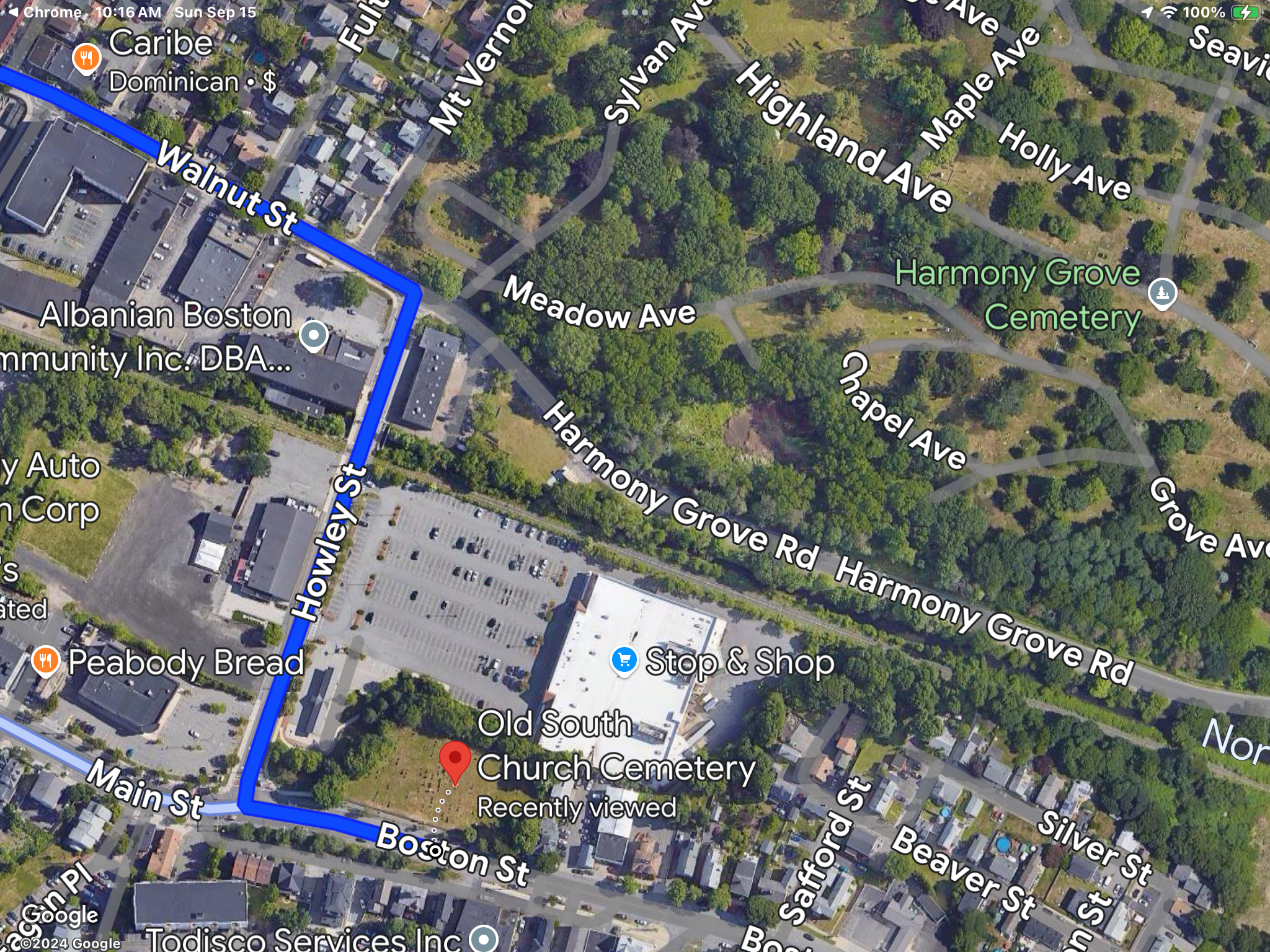
William Poole was buried at Old South Cemetery, Peabody, Essex Co., Massachusetts


I have two direct lines from William, the stones are below.

Ward Poole
 Born:  April 17, 1763, Danvers, Essex Co., Massachusetts
Died:  November 14, 1828, Salem, Essex Co., Massachusetts

His wife, Rebecca Seccomb (below)
Rebecca Seccomb
Born:  March 25, 1762, Danvers, Essex Co., Massachusetts
Died:  November 23, 1832, Danvers, Essex Co., Massachusetts

Ward and Rebecca were my 3rd great-grandparents.
Both are buried at Harmony Grove Cemetery, Salem, Essex Co., Massachusetts

Fitch Poole, brother of Ward, son of William (both above).
Fitch Poole
Born:  February 13, 1772, Danvers, Essex Co., Massachusetts
Died:  January 22, 1838, Danvers, Essex Co., Massachusetts

His wife, Elizabeth "Eliza" Cutler
Born:  July 04, 1779, Hamilton, Essex Co., Massachusetts
Died:  April 22, 1854, Danvers, Essex Co., Massachusetts

Fitch and Elizabeth were my 3rd great-grandparents.
Fitch and Elizabeth were buried at Harmony Grove Cemetery, Salem, Essex Co., Massachusetts.

Sunday, July 11, 2010

Longest Obituary I've Ever Seen

I've had the obituary for a good 12 years, and it finally got read as I typed it.  With one hand on a magnifying glass and the other in spell check, the below is what was written.  The photo at the left was in the middle of the obituary and it is a etching of my 2nd great-grandfather. Because this is about him, and how I found this brings back sentimental feelings of joy. I have not been able to locate a death certificate.  It took another year before I discovered where he was buried....in my own back yard, so to speak!  Sections in red might be of interest to some readers.

“THE NEW YORK TIMES, FRIDAY, MARCH 2, 1894

Dr. William F. Poole Dead

HE MADE LIBRARIANSHIP KNOWN AS A PROFESSION.

A Lover of Books, He spent His Life Among Them—As Librarian and Organizer He Developed His Profession on Lines of Greatest Utility—His indexes Valued on Two Continents—His Recent Great Work in Chicago.

CHICAGO, March 1—William Frederick Poole, LL D., died at 8 o’clock this morning in his home in Evanston.  His serious illness had caused alarm among his friends for several days, and his death was not unexpected.

Few men have done more to elevate and dignify the profession of librarian and to develop it along the lines of practical utility than William Frederick Poole.  Forty years ago librarianship was hardly known as a profession.  Most of the librarians of that day were men who had drifted into the pursuit from some other occupation in life.  Few, if any, chose it as a life work.  Now it has come to be recognized as a profession demanding and compensating first-rate abilities.

Dr. Poole was born in Salem, Mass., Dec. 24, 1821, the son of Ward and Eliza (Wilder) Poole.  He was a descendant of the seventh generation of John Poole, who came from Reading, England, with the first settlers of the Massachusetts Colony, resided in Cambridge in 1632, and in 1635 was the leading proprietor in the settlement of the town of Reading, Mass.  Mr. Poole attended school in Danvers (later South Danvers, and now, Peabody) until he was twelve years old.  Between his twelfth and seventeenth years he was out of school, learning the jeweler’s trade in Keene, N.H.  In 1835 the family moved to Worcester, Mass., where he spent a year in farming, with his father.  He then returned to Danvers, engaged a year in mercantile business, and later, in the employ of an uncle, learned the ancestral trade of tanner.

Finding himself not quite at home either as jeweler, farmer, or tanner, he got back to his books, and his seventeenth birthday found him fitting for college at the Leicester Academy.  In 1842 he entered Yale College, but after one year of study was obliged to stop to earn sufficient money with which to complete his course.  The next three months were devoted to teaching, and then he returned to Yale, entering as a sophomore in 1846, and graduating in 1849 in the same class with President Dwight.  In the last tern of his sophomore year, Mr. Poole was appointed Assistant Librarian of the Society of Brothers in Unity, which has a library of 10,000 volumes.  He had been in the position but a few weeks when he saw that the great need of the students was some mean of ascertaining what the bound sets of periodicals contained.  He went about supplying this want by preparing an index to them, and in a year he had the work so far advanced that the society voted to print it.

While the printing was in progress Mr. George P. Putnam of this city assumed the whole pecuniary responsibility of its publication, and the work appeared in 1848, with his imprint, under the title of “Index to Reviews and Other Periodicals to Which the Indexes Have Been Published.”  The entire edition was soon exhausted, and the author immediately began the preparation of a larger and more comprehensive work on the same general plan.  With all this extra work, young Poole maintained a rank of scholarship which secured him an election among the first to be the Phi Beta Kappa Society of the college.  The first year after his graduation he spent in completing his “Index to Periodical Literature,” which was not, hover published until 1853.  The first “Index” contained 154 pages octavo; the second 521 pages.  The third edition of the “Index” appeared in 1882, and contained 1,489 pages, royal octavo.  This was prepared with the co-operation of the American Library Association and the Library Association of Great Britain.  The “First Supplement” to this index was published in 1887.

In 1851 Mr. Poole became Assistant Librarian of the Boston Athenaeum, and the next year Librarian of the Boston Mercantile Library.  During his four years in that position he prepared and printed a dictionary catalogue of the library on the “title-a-line” principle which has been so widely followed since, and also brought out his second “Index.”  From 1856 until January, 1869 Mr. Poole was librarian of the Boston Athenaeum, which had, at the time he became its director, 100,000 volumes.  During his administration, with the assistance of Mr. Charles Russell Lowell, a brother of James Russell Lowell, the excellent catalogue of the library, since printed in five large volumes, was begun.  It was completed by his successor.

On leaving the Athenaeum, Dr. Poole was occupied during the next year as a library expert for the organization and general management of libraries.  He organized during that year the Bronson Library at Waterbury, Conn., and the Athenaeum Library at St. Johnsbury, Vt.; rearranged and catalogued the Naval Academy Library at Annapolis, Md.; selected and purchased the books and had the general direction of the Newton and Easthampton (Mass.) Public Libraries.  In the Fall of that year he was invited to reorganize and take charge of the Cincinnati Public Library.  This invitation he accepted, and for four years held the office of Librarian.  During these years the Cincinnati Library Building was erected, at that time the finest and largest building of the kind in this country. In October, 1873, he was appointed Librarian of the Chicago Public Library, and entered upon his new duties Jan. 1, 1874.

The institution had then a reading room and about 700 volumes, which had not yet been catalogued or made accessible to the public.  May 1, 1874, the library was opened with 18,000 volumes.  In less than two years it had increased to 57,000, and now is said to have the largest circulation of any single library in the country.  During his years of connection with this library Dr. Poole was often called upon for advice and assistance in the formation and management of libraries throughout the country, especially in the Northwest, where his influence in favor of the public-library system was great. In 1887 he was elected Librarian of the Newberry Library in Chicago. This is a library of reference solely, and was founded by the late Walter L. Newberry of Chicago, who left $3,000,000 for the purpose.

This library is the crowning work of Dr. Poole’s life.  Its collection was begun in 1887, but it was not until last year that the beautiful building erected for it was occupied.  The building faces Washington Square, on the north side of the City of Chicago.  It is Spanish-Romanesque in architecture and built of granite.  Only one wing, the frontage on one of the four sides of the block on which the building stands, has been erected, but this is very imposing.

When completed, the building will hold 4,000,000 volumes.  An auditorium to seat 475 people, is one of the features of this building.  This was provided to carry on university extension work, in which Dr. Poole was particularly interested.  He was the one to inaugurate it in Chicago, and he was actively engaged in it up to the time of his death.

The number of volumes in the library is 117,000, and there are 46,000 pamphlets.  These were carefully selected by Dr. Poole to meet the requirements of the scholars.  The department of biography in large and complete, and a remarkable collection of the sources of American history, including biography, genealogy, State and local town histories and other original documents, is one of the features of the library.  The department of music is said to be the best and largest in the country.  These are only a few of the departments in which the library excels.

Dr. Poole so outlined the work that his successor, whoever he may be, will have no difficulty in carrying on the work of making the Newberry the best reference library in the country, as he planned.

Dr. Poole was among the first to recognize the value of concerted action among librarians to advance the interests of their work.  He was a member of the convention of librarians held in this city in September, 1853, which was the first meeting of the kind in the world. Upon the organization of the American Library Association, in 1876, he was made one of its Vice Presidents, and continued in that office until his election in 1885 to the Presidency of the association.  He was one of the party from this country which attended the first conference of English librarians in London in 1877, and was a Vice President of that meeting.  Dr. Poole devoted much attention to library architecture and his several papers on this subject attracted much attention, both in this country and in Europe.  He was a leader in the movement for practical utility and convenience in library buildings, as opposed to the old conventional style, in which use was sacrificed to impressiveness of architectural effect.  In other departments of library arrangement he manifested no less activity and fertility of practical ideas.  The “Report on Public Libraries,” issued in 1876 by the United States Bureau of Education, contained several papers by him, prominent among them one on “The organization and Management of Public Libraries,” which gave practical directions on all essential points connected with this work, and is still generally recognized as a standard authority on the subject.

Aside from the works already named, Mr. Poole’s writing were mainly in the direction of American history and historical criticism.  He was especially interested in the early history of New England and that of the West, and for thirty years was a constant writer for the periodical press on subjects connected with these studies.  Controverting the charges brought against the New England clergy of fomenting the witchcraft persecution, he published several articles in 1885-9 which attracted general attention.  Chief among them was the one called, “Cotton Mather and Salem Witchcraft,” in the North American Review for April, 1889.  In the “Memorial History of Boston” he wrote the chapter called “Witchcraft in Boston.”  In the North American also appeared his articles on “The Popham Colony,” October, 1868, and “The Ordinance of 1787,” April, 1878, the former intended to dispose of the Maine claims to priority of settlement over Massachusetts, and the latter for the first time giving the secret history of the famous ordinance.

In 1870 he discovered in the Massachusetts archives a manuscript of Gov. Thomas Hutchinson on the “Witchcraft Delusion of 1692,” which he printed in the New England Historical and Genealogical Register for October, 1870, and also a separate form, with copious notes, illustrating the bibliography of New England witchcraft.  He also wrote two other pamphlets on the subject of witchcraft and three anonymous pamphlets on the dictionary controversy – “The Battle of the Dictionaries,” 1858; “Websterian Orthography: A Reply to Dr. Noah Webster’s Calumniators,: 1858, and “The Orthographical Hobgoblin,” 1859.  In 1887 Mr. Poole reprinted a rare and curious work which appeared in London in 1854, (the first printed history of the Massachusetts Colony) entitled :Wonder-Working Providence of Slon’s Saviour in New England,” to which, he wrote an elaborate introduction of 154 quarto pages, besides preparing an index.  His “Anti-Slavery Opinion Before 1800: was based on a paper he read before the Cincinnati Literary Club and was printed in Cincinnati in 1872.

In 1874-5 Dr. Poole edited in Chicago a literary monthly called The Owl, and was also a constant contributor to The Dial after it was started in 1880.  His work was always to the nature of a plea for judicial fairness and candor in historical writing, and his pen was constantly on the alert to discover and expose the pet fallacies of the vilifies of the fathers  of New England.

Dr. Poole for a number of years was the President of the American Historical Society, a member of the American Antiquarian Society, and of the Essex Institute, and corresponding member of the Historical Societies of Massachusetts, New York, Pennsylvania, Maryland, Wisconsin, and various other States.  He received the honorary degree of LL D. from the Northwestern University in 1882.  Mr. Poole was married Nov. 22, 1854 to Miss Fanny M. Gleason, daughter of the late Dr. Ezra W. Gleason of Boston.  Of seven children born to them, four are living.  Dr. Poole’s personal qualities were such as to contribute in no small degree to the success that he achieved.  Of commanding and yet affable and pleasing address, he combined in a rare degree the force needed for large executive responsibilities with the tact which secured the hearty loyalty and the affection of his subordinates.  He imparted his own enthusiasm and his eminently practical views in library work to a large number of those who are now filling places of importance in the library profession having served an apprenticeship under him.”


Note: I had the obituary scanned and saved in jpeg format.  Thank you Mark for doing this for me.
(But I can't read it!)  But....See this from the New York Times.


Friday, July 9, 2010

Stone House Day in Hurley, New York -- Back in Time


Do you want to go back in time?  One of my favorite genealogy experiences was to travel to Hurley, Ulster County, New York, an hour west of Albany, and spend a good part of the day touring old houses in the town that was settled in 1661.  There is another reason I went, my ancestor, Matthys Ten Eyck lived there and he and his wife are buried there. I'm not talking about recent events, but the early 1700s.

Stone House Day is an annual event, and the 60th one will be held tomorrow, July 10th.  They must be doing something right. And what fun for the entire family.  From the website,
You can see the other attractions:

• a 1777 Ulster Militia Encampment,
• guides in colonial attire,
• crafts and demonstrations, and
• a Town Library Fair, with collectibles and book sales.

Also from their website, "The first inhabitants of Hurley were the Esopus Indians, members of the Algonquin Nation’s Delaware tribe. In 1661, a few Dutch farmers moved in, and the next year the settlement was surveyed, lands were officially granted to twelve Dutch and Huguenot families, and the village became Nieuw Dorp, meaning “New Village.” "Peter Stuyvesant later owned about 200 acres of land here." And, "Most settlers returned to rebuild their village, but in 1664 the British had taken over the entire “New Netherlands” colony and in 1669, named the village “Horley,” after the ancestral estate of English Governor Lovelace on the Thames, not far from London. Hurley at one time included portions of what are now the Towns of Marbletown, Rosendale, Woodstock, and New Paltz. But the Dutch language persisted for 150 years more among the stubborn anti-British residents.


Today, 25 of the original stone houses still exist—200 to 300 years later. All are privately owned homes except for the Hurley Museum. Descendants of the first settlers still reside in some of the homes."

A few photos from my past trip.


Front and back of the Matthys Ten Eyck's house.
(We were able to tour inside the house.)
He was my 7th great-grandfather.


Tombstone of Matthys Ten Eyck.

Various photos.

Tuesday, July 6, 2010

Tombstone Tuesday -- Cemeteries (How could I not take these)


Last month, my husband and I took a little trip to New Hampshire and Quebec, Canada and came upon three lovely cemeteries.  Of course, a quick stop to check out a rainbow proved to be the best thing.  I always wanted a rainbow shot with a cemetery in it.

These two shots were taken in Colebrook, New Hampshire.


East Hereford, Compton County, Quebec
(In my haste to get photos uploaded, I deleted the one with the sign, but you can see it via the link above.)

A few miles up the road, another nice cemetery.

East Hereford, Compton County, Quebec.


Within 3 minutes, we went from New Hampshire, to Vermont to Canada.
Vermont on the left and New Hampshire on the right.
The beginning of the Connecticut River.
Connecticut River in Massachusetts (further south of above).

Friday, July 2, 2010

Follow Friday -- Riverdale, Michigan

Why write about Riverdale, Michigan you might ask.  My 6th cousin recently sent me a 75 page Centennial booklet for her town with a "population of 300-400 if everyone is home."  She lives in this town.  We began sharing our family information a good four years ago and we stopped, some time passed and we started up, this has happened several times.  Nice to have relatives like that, somebody you are comfortable with and who will share.


Because I knew nothing about Riverdale in Seville Township, I checked with google and found a site about
Gratiot County, Michigan, it appears to be in the center of the state, and the Pine River runs through it.  From the booklet, I learned that lumbering was abundant, and the finest pines could be found there in the early days. "In 1854, lured here by the forest of pines, white people started to settle in the area.  Large log drives used to take place where millions of feet of logs were floated downstream to the mills which soon started along the banks."

My ancestors on our shared Schrambling / Scramlin line settled in Michigan, but not this town.  However, cousin Linda had several generations who live there, and currently her parents have a life-lease on a farm, and Linda also resides there.

The town celebrated their Centennial in 1974, and then in 1999 this book was published, which contains some of the original material as well as updates from the past 25 years.  Throughout the book are old and new photos of schools, houses, churches, banks, old sawmills and other buildings. And, many old family photos.  Linda kindly went through each page and wrote on stickies additional bits of information.  There is even a photo of her 130+ year old house, one of oldest in the town!

I particularly enjoyed the piece about the Riverdale Library. "It was started in June of 1941 by Mrs. Josephine Scramlin Bradley.  She collected a few books from the townspeople and borrowed a number of books from the State Library in Lansing." This wonderful lady was Linda's great-aunt!

While trying to locate additional information about the town, I found a listing of some burials at Riverdale Cemetery from Google images.

I no longer have the need to keep her book, and Linda has allowed me to donate it to the New England Historic and Genealogical Soceity's Library (NEHGS).  It will have a safe home, and perhaps others will use it.


Tuesday, June 29, 2010

Tombstone Tuesday -- KILBORN of New Haven, Connecticut


Aaron Kilborn
Born:  September 03, 1798, Killingworth, Middlesex Co., Connecticut
Died:  August 29, 1876, Orange, New Haven Co., Connecticut

His wife, Almira Richardson
Born:  Abt. 1798, Orange, New Haven Co., Connecticut
Died:  April 22, 1861, New Haven, New Haven Co., Connecticut
 
They were my 3rd great-grandparents. 
They are buried at Evergreen Cemetery, New Haven, Connecticut.


Their son was George Franklin Kilborn
George Franklin Kilborn
Born:  October 30, 1832, Hamden, New Haven Co., Connecticut
Died:  December 16, 1910, New Haven, New Haven Co., Connecticut

His wife, Sophia Polly Davis
Born:  January 11, 1831, Guilford, New Haven Co., Connecticut
Died:  May 03, 1928, New Haven, New Haven Co., Connecticut
 They were my 2nd great-grandparents.
They are buried at Grove Street Cemetery, New Haven, Connecticut
Note:  Yale University is in the background.


Saturday, June 26, 2010

Conversation -- Part 3 Best Thing I Ever Did, I wrote a Letter to Mr. Barnes.

My letter began with, “Dear Mr. Barnes” unfortunately, I didn’t save a copy of my letter nor did the recipient.  Now for the beginning. About 1996, I used a genealogy book, The Genealogy of Thomas Barnes of Hartford, Connecticut, and was so happy to discover that my ancestors were listed in the book, with a source! It was for the marriage of ESTHER BARNES and NATHANIEL BISHOP of Connecticut. 

Immediately, I wrote the author a letter, since his address was printed in the book. Within days, I received a reply.  It seemed he was more excited than me. Why?  He was born and brought up in my home town. Even though he now lives in California, some of his family is still living here in my town in Massachusetts.

When I decided to write about the letter, his book and our meetings, I contacted him and his wonderful wife, Edna.  Edna replied back, “As far as we can determine, it looks as if we first met in October 1997 at the Library. I remember when you came bouncing in all enthused. It was such a pleasure to meet you. Also, we believe that Fred has visited with you in person four or five times. He has visited with you twice by himself. In August 2009, I returned back to CA earlier than Fred so he met with you and did some additional visiting with relatives and "old" classmates. He also was able to see you when he went back to his 50th High School Class Reunion in 2001. When we both went back for his 55th High School Reunion in 2006 you met us in Andover, MA. I'm not sure what year it was that you welcomed us into your home. You were doing some remodeling but wanted to share some of your genealogy material with us at that time.  Please let us know if you have any questions regarding Fred and his home town as he was "growing up".

This wonderful friendship developed because of a simple letter.  In addition, Fred is also my 8th cousin, but it feels like a 1st cousin with both of them. They are both members of my local genealogy club, long-distance from California.

If you have a BARNES line in your family, chances are pretty good, that person is in Fred’s two-volume set, reprinted 2001.  Please contact me if you wish further information.
 

Friday, June 25, 2010

Conversation - Part 2 We met at the Microfilm Reader and discovered we were Cousins

After three hours of looking through microfilm at the New England Historic and Genealogical Society’s Library (NEHGS) in Boston, I was getting pretty tired. In addition, I wondered about the man who was sitting next to me, who was also doing the same thing. There we were for all those hours, getting up to get a new reel, making copies, putting it back to get another one. Finally, I decided to start a simple light conversation. Something like, “what are you working on?” You know the answer, don’t you? Turns out, we were both working on Canadian censuses, for the exact same location…and the same family! We might have been looking for other names as well, but we were both looking for Westover names. Yes, the exact same surname as Gail (from yesterday's blog) and I have. My new found cousin, Jim and I couldn’t believe our luck, and I couldn’t wait to call Gail to share the news.

Unfortunately, Jim lives in New York City, and he was leaving in a few days. He took a temporary court stenographer’s position in Boston, so he could use the library for his Canadian research. We of course shared much information after he returned home. On two trips to NYC, before September 11, 2001, my husband and I met Jim at the New York Public Library for quick visits. He obtained some legal documents through the Missisquoi Historical Society in E. Stanbridge, Quebec, typed them up, and sent me a copy.

These encounters had surprising results, but to have two, with the same surname is pretty much unbelievable, I think. But they are both true, and that is why these blogs on Conversation were the very first I was going to blog about.

In the past, when I attended conventions, I always had my major surnames printed on the back of my business cards to hand out. Doing that simple step might help make a connection. Although, I think most people at conventions aren’t really looking to find cousins (that is what the internet is for), but it could work, either with the cards, or with chatting with the person next to you.  Part 3 of Conversation has to do with writing to an author.

Thursday, June 24, 2010

Conversation -- Part 1 My hustand talked to a club member and discovered I was related to her!

Close to 12 years ago, our new local genealogy club had their first annual pot-luck dinner at a sports club.  At least 30 people were there, and I only knew a handful of them.  Fortunately, my husband was sitting next to an older lady and they struck up a conversation.  I suppose one thing led to another, and they exchanged names.  Low and behold, her married surname was familiar to my husband because I was working on that surname for my tree.  Gail, the daughter, came over and she was also working on that exact same line!  We had so much to chat about. She was my first found cousin, a 6th one at that. The most exciting thing was, mother and daughter were planning on going to the Eastern Townships in Quebec, Canada the following summer to find cemetery stones and to do some research.

When they returned from their trip to Sutton, Dunham, and Frelighsburg, Quebec, Gail had duplicate copies of all her photos made for me, and a written copy of the inscriptions.  How could a person get any luckier?

Now, you can probably guess that I also had to make the same trip.  So three months later, my husband and I, using Gail’s local map for that area, retraced part their trip.  From Massachusetts, we went through Vermont and into Canada north of Burlington, it probably took close to six hours. We spent three nights at a lovely modern bed and breakfast, and managed to understand the inn keepers, who spoke mainly French.  Although this area is mostly English speaking, there are a fair number who speak French.

Years later, my cousin bought a series of books, the vital records for the above named towns, and I was able to borrow them.  It sure helped that I didn’t have to buy them as well.

When I first began blogging, this story was one of the first things I was going to write about, and now many months later, I am finally sharing it. The point of all this is, it is important to communicate with others who share your hobby.  I have learned this twice.  Part 2 will illustrate another example.