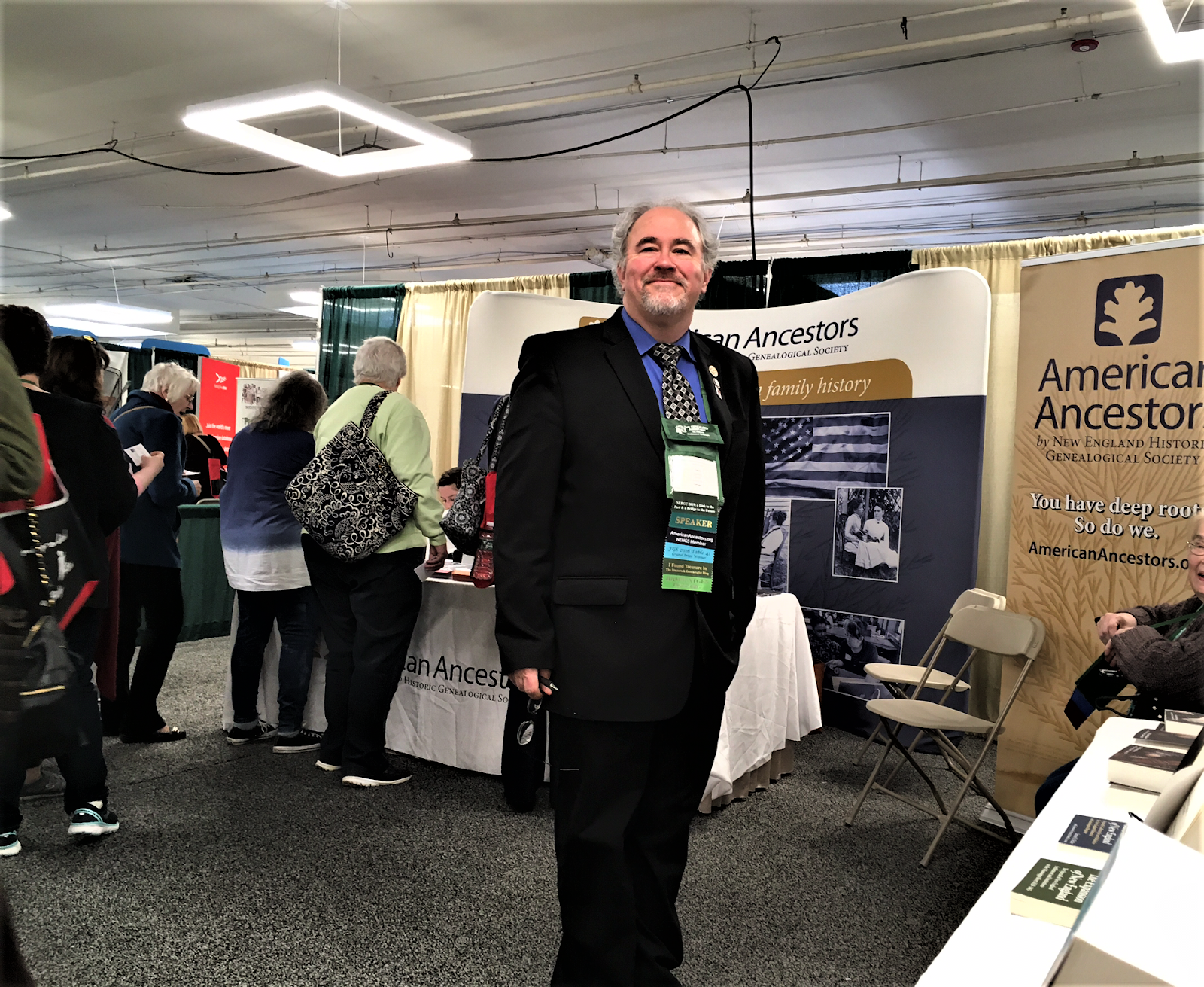
So what is NERGC? It stands for New England Regional Genealogy Conference. It is held every two years, and the past four days it was held in Manchester, New Hampshire. As you can see from the above photo, there were many smiles and a baby! I met at least four people I've known for 15 years or more. My husband Bill knew four. And, in addition he had the ear of Michael, Diane L. and Diane S., Juliana and Christa (both from Ancestry) an ear. I wanted to post them to facebook, but only five would upload, so I'm posting through my blog.
Pages
The Life From The Roots blog topics have changed several times since I began this blog in 2009. I initially wrote only about the family history I had been working on for 20 years. Years later, I was into visiting gardens, historical homes, churches, libraries that had genealogical collections, historical societies, war memorials, and travel/tourism places. I also enjoy posting autographs and photos of famous people I've met or have seen.
Along with my New England roots, other areas include New York, New Jersey, Michigan, Illinois, Wisconsin, and the Eastern Townships of Quebec, Canada.
Please check out the labels on the right side for topics (please note, they need work). Below the labels and pageviews is a listing of my top nine posts, according to Google. Four of them pertain to Lowell, MA. These posts change often because they are based on what people are reading.
Saturday, April 6, 2019
Tuesday, March 26, 2019
Where are Some Participants of the Boston Tea Party Buried?
Earlier this March, my husband and I played tourists in Boston. Although there was snow on the ground, it was a nice day for plenty of walking. I came across a sign at King's Chapel Burying Ground listing many of the participants of the Boston Tea Party, so I decided to show the cemeteries where they were buried. The first three listed are very near each other, but because of the snow, we didn't walk through them. The last photo was taken in the summer and is a distance away. Last year I did a post, "How Do You Find Your Ancestors in the Boston Cemeteries?" This post tells you exactly how to see if your ancestors were buried in Boston and in which cemetery.
Central Burying Ground (located in the Boston common).
Thomas Bolter
|
David Bradlee
|
Josiah Bradlee
|
Nathaniel Bradlee
|
Thomas Bradlee
|
Amass David
|
Robert Davis
|
John Gammell
|
Edward Compton Howe
|
John May
|
Henry Purkitt
|
Samuel Sprague
|
John Spurr
|
Bartholomew Trow
|
Josiah Wheeler
|
Granary Burying Ground.
Henry Bass
|
Seth Ingersoll Brown
|
Thomas Chase
|
Ezekiel Cheever
|
Adam Collson
|
Joseph Eaton
|
Samuel Gore
|
Joseph Lee
|
Matthew Loring
|
William Molineux
|
Thomas Moore
|
William Pierce
|
Paul Revere
|
Joseph Shed
|
David Williams
|
King's Chapel Burying Ground.
Thomas Crafts
|
William Haskins
|
Archibald Macneil
|
Thomas Melville
|
Isaac Pitman
|
Lendall Pitts
|
Samuel Pitts
|
Henry Prentiss
|
Copp's Hill Burying Ground.
Nathaniel Barber
|
Joseph Bassett
|
James Brewer
|
John Brown
|
Stephen Bruce
|
Benjamin Clark
|
Jonathan Clark
|
John Decarteret
|
Benjamin Edes
|
Thomas Fracker
|
Nathaniel Frothingham, Jr.
|
Samuel Hayward
|
Eleazer Gay
|
Moses Grant
|
John Hooton
|
Jonathan Hunnewell
|
Richard Hunnewell
|
Richard Hunnewell, Jr.
|
Daniel Ingersol
|
John Marston
|
Joseph Mountfort
|
Nathaniel Prentiss
|
Edward Proctor
|
Josiah Snelling
|
John Truman
|
Tuesday, March 5, 2019
ThruLines, and Wrong Assumptions Brought my "Brick Wall" Down
| Almira Byran (Richardson) Kilborn |
Last week during the huge genealogy RootsTech conference in Salt Lake City, I listened, from home, to Christa Cowan, of Ancestry.com give a presentation about new tools to use for doing genealogy research. One genealogy "toy" was called ThruLines, and I began checking out my tree immediately. This tool uses your tree and DNA then matches you up with others who share the same DNA and similar trees. I'm not sure how many of my ancestors came up, but there were about 98% correct ones. The match-ups appear as small cards with the name and dates, then you click on them to find more information (samples below). I had four that surprised me because I entered them purposely in my tree about 25 years ago. You see, my 3nd great-grandmother was Almira Richardson, and she was adopted by John Bryan and Mabel Clark.
This post was rewritten several times because over four days, I kept finding different information through research. The most important thing to me, and a suggestion to you, is to be sure you have no assumptions.
My five assumptions were all wrong:
I assumed ThruLines was wrong, because the names of Bryan were shown to be my 4th and 5th grandfather, and not Richardson. How could that be?
I assumed Almira was the daughter of Ebenezer Richardson, because he names her in his will as a daughter, and states she is the wife of Aaron Kilborn (this is correct).
I assumed John and Mabel (Clark) Bryan were the adopted family, based on a church record stating, "Almira Richardson adopted daughter of J. Bryan."
I assumed the children of Almira and her husband, Aaron Kilborn were named for her husband, and two aunts of her husband.
I assumed her father, Ebenezer Richardson and mother (unknown name until yesterday) had to have died, because Almira was adoped at the age of 16-17 yrs. of age.
What did I do?
Instead of dashing off a letter to Blaine, Christa Cowan or Ancestry.com to complain, I decided to research because now had a few clues through the Bryan and Clark ThruLines. I learned that there were 3 Clark daughters, one was my 4th great grandmother, (but who was she) and the other two were great aunts. I had no direct line through my 3rd great grandmother, but I had DNA through my great aunts, and both of them had a Richardson female as a descendant. Once I saw the surname Richardson, I dug deeper into that line.
I found Almira's father's will, but there were questions. He didn't die young (he died in 1826), so, Almira wasn't an orphan. She was among 8 daughters and 5 brothers, and now I discover that Mehitable was her mother in that will. But through more research, I discovered I was wrong again, and I knew it because the DNA didn't match mine (I have no DNA through the father, but a little through the mother).
After some Richardson research, I moved on to the Bryan and Clark lines. I learned that John Byran married a Mabel Clark, and it turned out she had siblings, Molly and Mehitable. Mable Clark Bryan died in 1815 when daughter Almira Richardson was about 17. Mehitable Clark married Ebenezer Richardson 1788, and they adopted Almira who took the surname Richardson. Thus Mehitable Clark Richardson was a aunt and a step-mother.
Almira Bryan Richardson's biological father, John Bryan was still alive, and he married Molly Clark 10 months later. (Molly Clark was her aunt.)
I did a triple look at the Records Relating to the Church and Congregation in the Parish of North Milford, 1804, Book II A. Page 10 shows the record of marriages solemnized by E. Scranton. "1820, April 6, Almira Richardson adopted daughter of J. Bryan." I took that statement to mean Almira was a Richarson and was adopted by J. Bryan. But yesterday I read that it meant, she was Almira Bryan and adopted by a Richardson. (This record was found at Salt Lake City about 20 years ago.)
Below are my four ancestors who showed up in my ThruLines. Unhappy at first, but very glad I solved my old "Brick wall" and for those who have read my blog over the 9+ years, I no longer am offering $100 for somebody to solve this mystery for me.
When the above names appeared and I got over being shocked, I knew this could be a story, so I named first draft of this post, "Use the Wrong Name, You Might Get the Right Information."
Well, wrong names CAN point you into the right direction! The above ancestors are mine.
After I "solved" who my male Richardson ancestor was or more accurately wasn't, I went back to these two charts (above and below), and saw that Mabel Clark Lines (below) is my 5th great-grandmother, and daughter Mehitable Clark is my 4th great-aunt.
In the paragraph below, assumed father, Ebenezer Richardson named his 13 children, 8 daughters and 5 sons. One was names Myra, which is a nickname to my Almira.
My wrong assumptions were based on these two proofs:
The eight daughters and five sons were named in the will (above).
"Myra the wife of Aaron Kilborn" (above.)
New Haven Probate Records, Vol 6-8, 1816-1845
Marriage of Almira Richardson, adopted daughter of J. Bryan.
Nurse Frances and the Flu
For many years, I always knew the year my grandaunt, Frances Poole (born 27 Oct 1886) died, but I didn't have the date, location or cause of death. Imagine my surprise when at long last, I began researching her life and trying to find out why she died so young.
Suddenly, this 32 year old became alive, instead of just a name with death date of 1918. I found out she was a nurse. What a brave young woman to travel from the Chicago area to New York state to help the sick. She came from a rather wealthy family, was single and probably had all the wants and needs of her day. Her father, a patent attorney had died four years earlier and left her a house and the lands at 1015 Forest Avenue, Evanston, Illinois. She was the oldest of four children, although the paper only named two. Her maternal grandfather was William Frederick Poole, the head librarian at the Newberry Library in Chicago, who died two years before her birth. She was among the first to die in New York of the influenza. Frances Poole died October 8, 1918. Of all those deaths, and my Frances was the one most important to me. I am saddened by how it happened, but I am so proud of her, a young woman trying to help the sick, trying to make a difference. I wish I knew more about her, but what I know, I won't ever forget.
All my sources came from newspapers and printed articles. I haven't located her death record yet.
From the Chicago Daily Tribune. Oct 11, 1918 - "Miss Frances Poole, Red Cross, from Evanston was buried yesterday in Rock Creek Cemetery, Washington D.C. Miss Poole daughter of Mrs Charles Clarence Poole, 1123 Maple Avenue, Evanston died Tuesday at Camp Ontario, Oswego, NY of pneumonia following Influenza."
From the Chicago Daily Tribune. Oct. 27, 1918, Pg. 15 was the following Death Notice:
"Poole - Memorial services will be held for Frances Poole, army nurse, daughter of Mrs. C. Clarence Poole, sister of Lieut. Charles H. Poole, A. E. F.; and Dorothy Poole, at St. Luke's Episcopal church, Hinman and Lee Sts., Evanston, Ill., at 4:30 o'clock Sunday afternoon, Oct. 27th."
From the Ontario Post, October 26, 1918, page 2 is the obituary of two nurses, Ida Ferguson and my Frances who was listed as Frances Pool, Poole. What is interesting is, I just learned that her mother, Anna Poole was with her daughter when she died. Anna traveled from Evanston, Illinois to Camp Ontario, Oswego, NY. Thanks to Mary Kay Stone from the Oswego County Historical Society.
I believe the photo below shows one of the first groups of nurses who arrived at Oswego, New York to attend the sick soldiers. I have a feeling that my relative is in this photo, as she died 8 October 1918.

Nurses at Fort Ontario, Oswego, NY, c. 1918.
Permission was granted to use photo by the Oswego County Historical Society. (8/2019)
From: Bell Telephone News
- Volume 8 - Page 52
"At Chapel this morning President Holgate will present to the University a huge service flag in honor of the Northwestern men in National service. Mr. Marsh is in charge of the program, which besides special music will include a speech by Nancy Knight who will tell of Women's War work in Evanston.
The flag was purchased by Elizabeth Ambuhl. Lucy Harrison and Marian Goodsmith helped her sew on the figure 1120, their service taking them back to the good old days of Betsy Ross. 1119 Northwestern men have gone in the service, and Frances Poole is going with the Presbyterian Hospital Unite, makes up the number. The blue star stands for the living and the gold star for the dead.
Four of our soldiers have already given their lives for their country. They are: Captain Robert Tracy Gillmore, Med. '92. Died at Ft. Oglethorpe, Ga., Jan. 20, 1918. Frank L. Seery, Arts-Ex- '18. Killed in airplane collision, Kekky Field, Texas, Jan. 21, 1918. Earl C. Adams, Arts, Ex-'19. Died at Ft. Sill, Okla., Feb. 3, 1918. G. W. Morton, Law. '16. Died at Camp Grand, Rockford, Ill. Feb. 2."
From:The Syllabus (Northwestern University),Volume XXXV, pg. 130.
Students Publishing Company, 1920 (Note: The link is no longer active.)
"To Frances Poole, the only woman among the Northwestern students who victoriously gave their lives in service, the University pays double homage. A resident of Evanston, a graduate of the high school, an active worker in St. Luke's church, and a popular member of the class of 1911, she was known and loved by many friends. She left the University in her junior year, entered a nurses training course and graduated from the Presbyterian hospital in 1915. Choosing the branch of work in which she could be of service to the greatest number, she refused to enter private duty and became welfare nurse at the Chicago Telephone Company's home in Warrenville where the operators go for rest. Later she was assigned by the Company to do home visiting in a district on the south side.
She was peculiarly fitted for the nursing profession because of the wonderfully joyous spirit with which she was endowed. Hers was a contagious cheeriness which carried her triumphantly through the most uninspiring tasks and difficult places. When the call came from the Red Cross for nurses, she enlisted, as all who knew her best expected she would do, and was assigned on August 1, to the General Hospital at Fort Ontario, Oswego, N.Y. As she had been a comfort and inspiration to the telephone girls under £ care, so she brought to bear upon her new tasks not only her technical skill but her courageously joyous spirit. 'What is the use of fighting,' she said, “if one cannot fight with a smile?
The last week in September when the influenza epidemic was at its worst, her patients were on an open porch exposed to a biting wind from off the lake. Except for two hours rest, she worked from four in the morning to seven at night, and often gave assistance to the night nurses after that. Because of weariness and exposure she contracted the influenza but refused to go off duty. Wearing a mask constantly, she remained for a week caring for the boys who needed her. Pneumonia set in and in five days she quietly slipped away. She had wanted to come home with colors flying and so she did."
From: Evanston History Center (Illinois) I found a full page about Frances (partial below).
Once the United States entered the Great War, her two brothers Clarence and Charles, both entered the service. Frances wanted to do her 'bit' too. She responded to the American Red Cross’ recruiting call. Nurses were desperately needed and Frances decided that she could take her skills as a nurse and apply them in service to her country. She was assigned to the military hospital (General Hospital No. 5) at Fort Ontario in Oswego, NY. The busy hospital staff cared for sick or wounded U.S. troops who had been brought back home from France.
At the time, to work in a hospital was nearly as dangerous as being near the front lines. In 1918, it became even more dangerous upon the outbreak of an international influenza pandemic, brought on by the global movement of people at war."
From two official records records about the The Great Pandemic of 1918-1919 in the United States:
"First Official Report of Influenza: The Public Health Service did not require states to report influenza before September 27th. New York first reported the presence of influenza on September 27th, but the disease was undoubtedly present in the state before that date.
On October 11th, the PHS said that 'Epidemics have been reported from Maybrook town (Orange County), Montgomery (Orange County), North Tonawanda, and Oswego. School and theaters had not been closed.' By October 18th, state officials admitted that influenza was prevalent throughout the state.
"The flu afflicted over 25 percent of the U.S. population. In one year, the average life expectancy in the United States dropped by 12 years."
This the house her father left to her in his will. The Redfin.com link for this address will show 26 beautiful photos of the house.
Frances Poole
"One star has turned to gold on the service flag of the Chicago traffic department. It is the star of a girl who has given her life in the service of others.
"Miss Frances Poole came to the telephone company on August 14, 1916, as a nurse in the welfare department. She made many friends among the girls in her visits to the sick and later, through her position as nurse at Margaret Mackin Hall where she lived for a year and a half, had an opportunity to become a close and intimate friend of hundreds of girls who were there at different times. It was while she was at Margaret Mackin Hall that she decided to offer her services to the Red Cross. She was not able physically to stand the test for overseas service; but was placed on the list for work in this country. While awaiting her call she filled the place of Miss Julia Goodman, who left the Oakland district for overseas Red Cross service. She made many friends among the girls in the South Side offices, and it was with regret that her resignation was accepted when the call came for service at Camp Ontario, Oswego, N. Y.
During the terrible epidemic which was very severe in Camp Ontario, Miss Poole did not spare herself and, though she had a severe cold and was urged not to go on duty, she saw the extreme need of the boys, and, like a brave soldier, fought the fight until she fell— a victim of pneumonia. Her mother reached her two hours before her death, bringing by her presence the greatest joy to her daughter that she could have had at the last.
Mrs. Poole has the sympathy of hosts of friends. She has given much for her country; two sons are in the service— Lieut. Charles H. Poole with the coast artillery 'Over There,' and Lieut. Clarence T. Poole with the Quartermaster Corps in Washington.
Miss Poole had an unusually sunny disposition and a friendly spirit which made her dear even to those who knew her only for a short time. She was "one of the girls," a good comrade giving not only advice which she, through her nurse's training could give so well, but giving herself. "Sunshiny Frances" was her mother's name for her and we can imagine that our golden star is more golden because it shines with the glory of a lovely character. Such stars are not lost but shine on with a steady radiance inspiring us all to give our best.
Miss Poole was buried at Rock Creek Cemetery, Washington, D. C, where her father was buried some time ago."
From: Daily Northwestern, Evanston, Illinois, Friday, April 5, 1918, Page 1.
"Star Honors Heroes --
From: Daily Northwestern, Evanston, Illinois, Friday, April 5, 1918, Page 1.
"Star Honors Heroes --
The flag was purchased by Elizabeth Ambuhl. Lucy Harrison and Marian Goodsmith helped her sew on the figure 1120, their service taking them back to the good old days of Betsy Ross. 1119 Northwestern men have gone in the service, and Frances Poole is going with the Presbyterian Hospital Unite, makes up the number. The blue star stands for the living and the gold star for the dead.
Four of our soldiers have already given their lives for their country. They are: Captain Robert Tracy Gillmore, Med. '92. Died at Ft. Oglethorpe, Ga., Jan. 20, 1918. Frank L. Seery, Arts-Ex- '18. Killed in airplane collision, Kekky Field, Texas, Jan. 21, 1918. Earl C. Adams, Arts, Ex-'19. Died at Ft. Sill, Okla., Feb. 3, 1918. G. W. Morton, Law. '16. Died at Camp Grand, Rockford, Ill. Feb. 2."
From:The Syllabus (Northwestern University),Volume XXXV, pg. 130.
Students Publishing Company, 1920 (Note: The link is no longer active.)
"To Frances Poole, the only woman among the Northwestern students who victoriously gave their lives in service, the University pays double homage. A resident of Evanston, a graduate of the high school, an active worker in St. Luke's church, and a popular member of the class of 1911, she was known and loved by many friends. She left the University in her junior year, entered a nurses training course and graduated from the Presbyterian hospital in 1915. Choosing the branch of work in which she could be of service to the greatest number, she refused to enter private duty and became welfare nurse at the Chicago Telephone Company's home in Warrenville where the operators go for rest. Later she was assigned by the Company to do home visiting in a district on the south side.
She was peculiarly fitted for the nursing profession because of the wonderfully joyous spirit with which she was endowed. Hers was a contagious cheeriness which carried her triumphantly through the most uninspiring tasks and difficult places. When the call came from the Red Cross for nurses, she enlisted, as all who knew her best expected she would do, and was assigned on August 1, to the General Hospital at Fort Ontario, Oswego, N.Y. As she had been a comfort and inspiration to the telephone girls under £ care, so she brought to bear upon her new tasks not only her technical skill but her courageously joyous spirit. 'What is the use of fighting,' she said, “if one cannot fight with a smile?
The last week in September when the influenza epidemic was at its worst, her patients were on an open porch exposed to a biting wind from off the lake. Except for two hours rest, she worked from four in the morning to seven at night, and often gave assistance to the night nurses after that. Because of weariness and exposure she contracted the influenza but refused to go off duty. Wearing a mask constantly, she remained for a week caring for the boys who needed her. Pneumonia set in and in five days she quietly slipped away. She had wanted to come home with colors flying and so she did."
From: Evanston History Center (Illinois) I found a full page about Frances (partial below).
"After graduating from Evanston Township High School, Frances entered Northwestern University. She left in 1911 in order to enroll in a nurse training program at the Presbyterian Hospital. She graduated from the program in 1915 and elected to become a “welfare nurse” to help those in need. First she worked for the Chicago Telephone Company’s home in Warrenville, IL. Later, she worked for the same company on the South Side of Chicago, making home visits to patients.
Once the United States entered the Great War, her two brothers Clarence and Charles, both entered the service. Frances wanted to do her 'bit' too. She responded to the American Red Cross’ recruiting call. Nurses were desperately needed and Frances decided that she could take her skills as a nurse and apply them in service to her country. She was assigned to the military hospital (General Hospital No. 5) at Fort Ontario in Oswego, NY. The busy hospital staff cared for sick or wounded U.S. troops who had been brought back home from France.
At the time, to work in a hospital was nearly as dangerous as being near the front lines. In 1918, it became even more dangerous upon the outbreak of an international influenza pandemic, brought on by the global movement of people at war."
From two official records records about the The Great Pandemic of 1918-1919 in the United States:
"First Official Report of Influenza: The Public Health Service did not require states to report influenza before September 27th. New York first reported the presence of influenza on September 27th, but the disease was undoubtedly present in the state before that date.
On October 11th, the PHS said that 'Epidemics have been reported from Maybrook town (Orange County), Montgomery (Orange County), North Tonawanda, and Oswego. School and theaters had not been closed.' By October 18th, state officials admitted that influenza was prevalent throughout the state.
Although state authorities were too overwhelmed by the pandemic to keep accurate records, they did attempt to record deaths. By late October, New York City, Albany, Buffalo, Schenectady and Syracuse reported elevated death rates. During the week of November 1st, the PHS reported a total of 12,357 deaths in New York City. For the previous six weeks a total of 30,736 deaths were reported. The actual number of influenza-related deaths during this period was probably much higher."
"In October of 1918, Congress approved a $1 million budget for the U. S. Public Health Service to recruit 1000 medical doctors and over 700 registered nurses. Nurses were scarce, as their proximity to and interaction with the disease increased the risk of death." Frances may have been one of the nurses who answered this call.""The flu afflicted over 25 percent of the U.S. population. In one year, the average life expectancy in the United States dropped by 12 years."
Frances and her parents buried at Rock Creek Cemetery, Washington, D.C.
1015 Forest Avenue, Evanston, Illinois.This the house her father left to her in his will. The Redfin.com link for this address will show 26 beautiful photos of the house.
Sunday, February 10, 2019
Did you Know that there is a New Quarter Honoring Lowell?
On Wednesday, February 6, 2019, the U. S. Mint and the Lowell Historic National Park celebrated the release of a new quarter that, "Honors Lowell National Historical Park in Massachusetts." The ceremony was held at the Lowell Auditorium at 10 am. I began hearing about this about 8 months ago, but the entire process from conception took 10 years. To read about the history, see https://www.uml.edu/news/stories/2019/lowell-quarter-anstey.aspx
(Below paragraphs from above article.)
"Lowell National Historical Park was among the 100 candidates listed on the ballot, so Anstey sprang into action, calling and emailing everyone she knew, asking them to vote “early and often” for the park.
Thanks in part to her efforts, Lowell National Historical Park beat out better-known federal sites in Massachusetts, including Boston’s Freedom Trail (Boston National Historical Park), Concord’s Minute Man National Historical Park and the Cape Cod National Seashore, to win the honor of being featured on the coin."
I bought a roll of newly minted Lowell quarters on Friday, February 8th, from a city bank. In a few weeks, they will be sold in the Lowell National Historical Park Visitor's Center. This information was told to me by the park ranger below. This is where I picked up the postcard, shown above.
You can see the detail work on this coin, but unfortunately, it's almost impossible to read what was written.


DESCRIPTION
2019 America the Beautiful Quarters® Program – Lowell National Historical Park Rolls and Bags
The Lowell National Historical Park quarter is the first in 2019 and 46th overall in the America the Beautiful Quarters Program.
Established in 1978, Lowell National Historical Park preserves and interprets the role of Lowell, MA, in the Industrial Revolution in America, mainly during the 1820s and 1830s. The park archives the history of the human story in addition to the industry processes and cultural environment of the time.
The nearly six miles of canals and waterways dug to provide power to the textile mills were of vital importance and nearly all are still in existence. Dependent on this water power, the first “integrated” textile mill (a mill with all operations under one roof) was built in Lowell. This factory represented a new type of mill—an operation with large scale equipment, no longer dependent on the spinning wheel and individual artisans to create fabric. This change revolutionized the way cloth was manufactured and exemplified the changes to manufacturing that were realized during the Industrial Revolution.
The era was also defined in part by the “Mill Girls,” young women who were recruited to work in the mills where they earned cash wages and lived in supervised, company-owned boarding houses. Coming mostly from New England farms, the girls signed on to the mills for work for a designated period of time. This female workforce was critical to the textile industry for many years. As a group, they became an important voice for labor by:
- advocating for better working conditions through the first Lowell strike in 1834 and the 10-hour work day movement
- supporting abolitionism
- embracing education
The reverse (tails) design depicts a mill girl working at a power loom with its prominent circular bobbin battery. A view of Lowell, including the Boott Mill clock tower is seen through the window, inscriptions are “LOWELL,” “MASSACHUSETTS,” “2019,” and “E PLURIBUS UNUM.”
SPECIFICATIONS
| Denomination: | Quarter |
|---|---|
| Composition: | 8.33% Nickel, Balance Copper |
| Weight: | 5.670 grams |
| Diameter: | 0.955 inch (24.26 mm) |
| Edge: | Reeded |
| Mint and Mint Mark: | Philadelphia – P |
Lowell National Historical Park and the United States Mint last week. Great to see a full house at the Lowell Memorial Auditorium, with the entire 4th grade of Lowell Public Schools, many other Lowell classes and students, coin enthusiasts from across the country, and so many of our partners, friends, and neighbors in Lowell and nearby communities in attendance. We especially would like to thank all of the partners who supported the event and made this historic community event possible (check the photos for more info). Look for Lowell quarters at your local bank, and start checking your change!
Thursday, January 31, 2019
I Wanted This to be About the Bikes or Siblings, But it Turned Out to Be About The House
Three siblings enjoying their bikes. The oldest girl is my mother, with long hair, something I've never seen before. A few weeks ago, my cousin sent this to me picture, and while I kept looking at them, and their different style bikes, I wondered where was the picture taken. That thought became my project.
Fortunately, or so I thought, I had taken pictures of where they used to live in the 1930s. But the two pictures below of 90 Adams Street, New Britain, Connecticut didn't show a part of a striped awning as shown above. Were they at a neighbors house, a park or their own yard? I had no clue. Quite a bit of time was spent on googling the address and looking at various images, checking out the neighborhood and this address on Google Earth. I even found quite a write up about the house, (see at the end).
These two pictures were taken in late spring in 2012, for my blog: https://lifefromtheroots.blogspot.com/2012/04/90-adams-street-very-special-place.html
The above photo was taken by Google Earth.
The information below states it was built in 1930 and since the shrubs are mature, and my uncle looked to be about four, I think both pictures were taken in 1932, but it wasn't included in the portfolio. None of the children were born there, but I came pretty close, since I was born in that city, and spent my first nine months of life here. The three siblings were never infants in that house. (My father was in the war, and my mother lived with her parents. My grandmother was the attending nurse when I was born, then at nine months, mom and I moved to California where my father was stationed.)
PUBLIC RECORD - Built in 1930, this 5-bedroom, 2-bathroom single family residential house at 90 Adams St, New Britain CT, 06052 is approximately 2,044 square feet. Movoto's Comparative Market Estimated Value is $333,172 with a value per Sqft of $118. 90 Adams St is located in the New Britain School District. The closest school is Lincoln School.
- County Hartford County
- Property Type Single Family Residential
- Beds 5
- Baths 2
- Building Area 2,044 Sqft
- Partial Baths 1
- Rooms 8
- Lot Size 9,583Sqft
- Year Built 1930
- Last Sale Price $105,000
- Last Sale Date 08/24/1999
- Style Colonial
- Exterior Walls Rock, Stone
- Roof Cover Slate
- Heating None
- Cooling Yes
- Fire Place 1
Subscribe to:
Posts (Atom)