Pages

The Life From The Roots blog topics have changed several times since I began this blog in 2009. I initially wrote only about the family history I had been working on for 20 years. Years later, I was into visiting gardens, historical homes, churches, libraries that had genealogical collections, historical societies, war memorials, and travel/tourism places. I also enjoy posting autographs and photos of famous people I've met or have seen.

Along with my New England roots, other areas include New York, New Jersey, Michigan, Illinois, Wisconsin, and the Eastern Townships of Quebec, Canada.

Please check out the labels on the right side for topics (please note, they need work). Below the labels and pageviews is a listing of my top nine posts, according to Google. Four of them pertain to Lowell, MA. These posts change often because they are based on what people are reading.

Saturday, May 3, 2014

Chelmsford, Massachusetts Has Gone Back in Time

Earlier today, I did a post about a May Breakfast I went to in Chelmsford. It wasn't until we left, that somebody mentioned how nice the area looked since they removed all the telephone poles, and put the wires and cables underground. Once it was pointed out, I could tell the difference, and it was nice seeing how this part of the town may have looked many years ago, before electricity. Many of the buildings were there before that time.
No telephone poles! New sitting area in the old green.
 Streets around the green. I must say, it looks great.

 Old 1879 Town Hall was recently renovated.
(New Town Hall is in another location.)
 Monument and Toll House.
Middlesex Canal Toll House 1832  Oldest Canal Toll House in America. Donated by Heirs of Judge Samuel P. Hadley.
 Old house, now a bank.
Harriet B. Rogers, assisted by Mary S. Byam, opened here in 1866 the Chelmsford School. The first in America to susccessfully teach lip-reading and speech to deaf children. In 1867 it was moved to Northampton as the Clarke School for the Deaf.
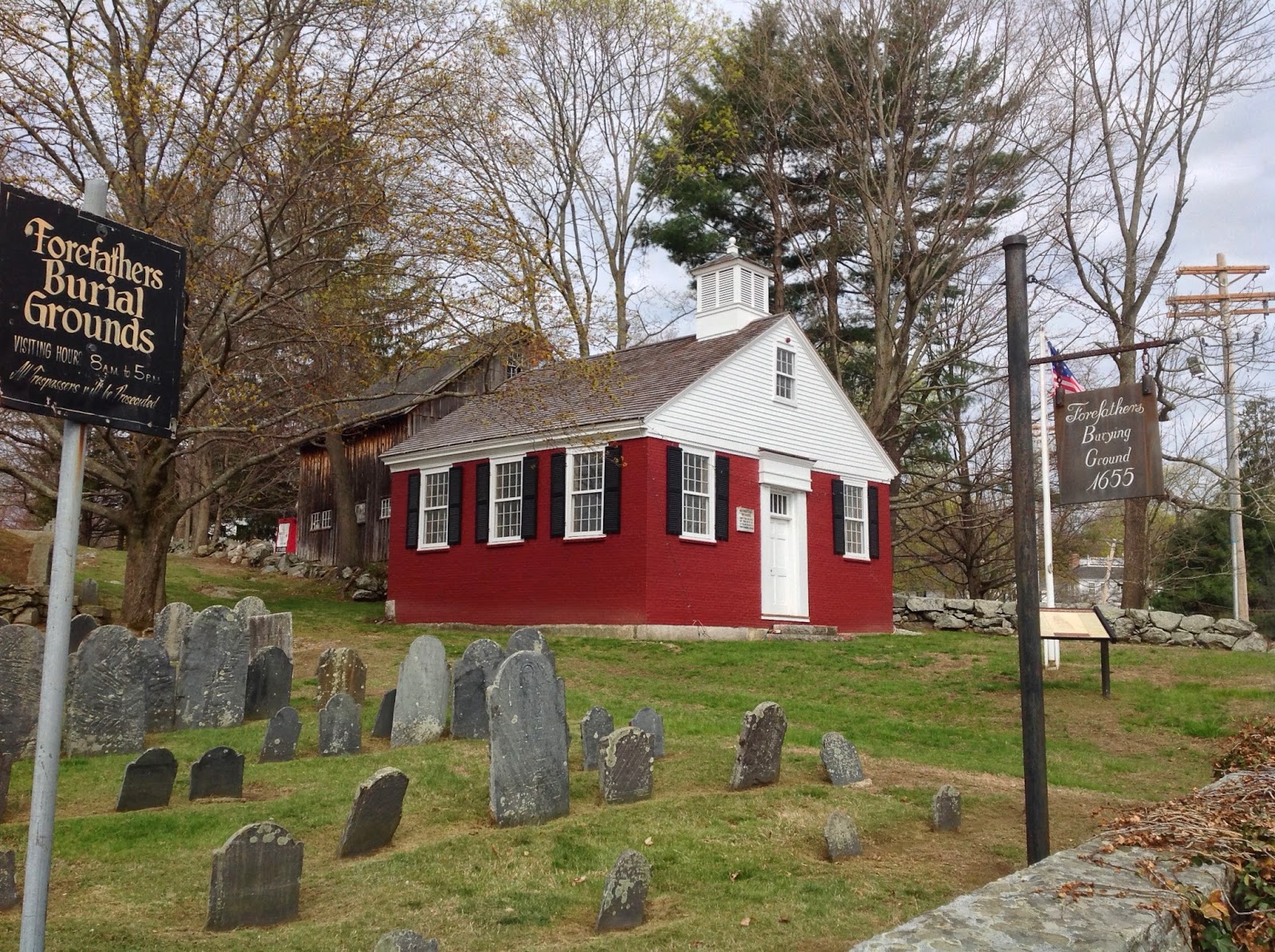
Next to the church, the 1655 Forefathers Burial Ground and old school.

Seeing Chelmsford, Massachusetts on May Breakfast Day

May breakfast on the first Saturday in May has been a tradition at my former church for 88 years. After a discussion regarding May breakfasts on facebook, some wondered if they were still being held. I knew of this one, so on this early spring morning, my husband and I went to it, only 5 miles away. Another post will follow, with more photos of the Chelmsford green. It was like seeing it for the first time, since they recently took out the power lines and improved the area, I even saw some historical sites, new to me.
Several signs around the church and on bulletin boards.

 We were early, so it wasn't crowded. Beautifully decorated.

 Oh the handmade baskets, each filled with six or so pieces of fudge.

 When I mentioned my mother and the elevator next to the table to where the baskets were being sold, both ladies got a little emotional. They knew my mother and still are so thankful that my mother left money to the church when she died. The church was able to install the elevator. Since I was curious if they needed to raise more funds, I was told no. One of these days, I'm going to have a plaque put there with her name.
 One of the ladies took me into the storage area to show me the additional baskets, it looked like a period room.
 Looking out the church window at the square.
 Real flowers and menu at each table.

  The "new" town hall is below, as seen from the church.

Chelmsford green, with church.

Tuesday, April 29, 2014

Lacey of Lowell, Massachusetts -- Tombstone Tuesday


 Fred Lacey
1860 - 1921

Maria Lacey
1854 - 1926
  Lowell Cemetery, Lowell, Massachusetts
Three small stones with initials of:
 G. S. L.
M. L.
F. L.

Wednesday, April 23, 2014

Newberry Library, A Bust and Portrait of my Ancestor Taken by Diane Boumenot

I wrote about the Library in my post, "A Library, A Librarian and Two Cousins" three years ago this month, and have always wanted photos of the interior. My genealogy friend and blogger, Diane Boumenot who writes the blog, One Rhode Island Family mentioned she was going to go to the Newberry Library in Chicago if she had time during a conference. I asked if she did, could she take photos for me. She did a year ago, and I am just now posting them. Thank you, Diane.

My ancestor was the first Librarian at the Newberry, and Diane was aware of that. Below are a bust and portrait of him, William Frederick Poole.


The Library stands on the site
formerly occupied by the
Mahlon D. Ogden residence
the only house in the path of
the great fire of 1871
which was not burned.

Presented by the General Henry Dearborn Chapter
Daughters of the American Revolution
1929

Poole's Index of Periodical Literature was written by my 2nd great-grandfather.


Tuesday, April 22, 2014

James Nichols of Reading, Massachusetts -- Tombstone Tuesday

James Nichols is my most recently discovered ancestor. Fortunately, he lived rather close to where I am now living, so that made it easy to visit his burial site at Laurel Hill Cemetery in Reading, Massachusetts. He was married to Mary Poole, but I was unable to locate her site.

This is my 147th photo of an ancestor's tombstone.
Here Lyes Buried
Ye Body of Mr.
JAMES NICHOLS
Who Departed this life
Jan. 12, 1744/5 in Ye 87th
Year of His Age.

I Shall Rise again.

James Nichols was my 8th great-grandfather.
Side view of headstone and foot-stone.


First row of tombstone in the old section at Laurel Hill Cemetery. Amazingly, they are of my Pooles, and I didn't know they were buried there.

Monday, April 21, 2014

Growing Up In Lexington


When I began my 4th fourth grade at the Adams School in Lexington, Massachusetts, I knew nothing of my new town's history.  My parents moved there from two previous towns in Connecticut, and from my first fourth grade in California.  I consider Lexington to be my favorite town of all the places I've lived.

Many of us have ancestors who fought in the Revolutionary War, as well as ancestors who were born in Lexington. I've several who fought in the War and were born there, and even my "brick wall" person, John Adams was in Lexington at the time of the war.

During several of my school years, our local history played an important part in our learning. My early classes took field trips down the street to see and learn about what happened. My Girl Scout troop planted flowering bulbs in the fall at some of the historic homes, and the church we attended was the tall one at the Lexington green.

Every April 19th, my Girl Scout troop marched in the Lexington Patriot's Day parade, there were two parades, I marched in the one at 7 AM! Of course, being much younger, I didn't mind, but sometimes it was cold. My mother was ecstatic about one 2 PM parade, when Sen. John F. Kennedy marched. I remember her pointing him out, but I thought, "who is he?" Both the 7 AM and 2 PM parades marched just two blocks from my house, and it was a very big deal. Many years after we moved, my mother always went back on that date to see it and visit with old friends. She even did that on the day she died, on her return trip home from Lexington. And whenever I returned for visits from Virginia, I always visited Lexington. Even now, it is about a 30 minute trip, so we go there frequently.

For eight years, I was in the Lexington school system, until my 11th grade, then we moved again. During my 8th grade, our class got to rename our junior high school, as there was another junior high being built. It had to have a patriotic name. I can't remember what I wrote about and why I chose the name, but the two winners were Diamond and Muzzy, so there were new names for each of the schools.  Many years later, Muzzy Jr. High became condos. Always changing, but then, nothing looks changed. It is a beautiful town, see photos below.

The town, April 11, 2010

Lexington Green

Cary Memorial Library

Afternoon parade, ca. 1960. I saw JFK march in one of these parades. 

Years after we moved, I had to show a boyfriend where I lived!

The house, photo taken three years ago.

Post was originally posted April 18, 2010.

Saturday, April 19, 2014

Listen My Children Poem


The Midnight Ride of Paul Revere

by Henry Wadsworth Longfellow
1807-1882

Written April 19, 1860; first published in 1863 as part of "Tales of a Wayside Inn"
Photo of the Battle Road Trail in the
Minute Man National Historical Park
(Lexington, Lincoln, Concord)

Listen my children and you shall hear
Of the midnight ride of Paul Revere,
On the eighteenth of April, in Seventy-five;
Hardly a man is now alive
Who remembers that famous day and year.

He said to his friend, "If the British march
By land or sea from the town to-night,
Hang a lantern aloft in the belfry arch
Of the North Church tower as a signal light,--
One if by land, and two if by sea;
And I on the opposite shore will be,
Ready to ride and spread the alarm
Through every Middlesex village and farm,
For the country folk to be up and to arm."

Then he said "Good-night!" and with muffled oar
Silently rowed to the Charlestown shore,
Just as the moon rose over the bay,
Where swinging wide at her moorings lay
The Somerset, British man-of-war;
A phantom ship, with each mast and spar
Across the moon like a prison bar,
And a huge black hulk, that was magnified
By its own reflection in the tide.

Meanwhile, his friend through alley and street
Wanders and watches, with eager ears,
Till in the silence around him he hears
The muster of men at the barrack door,
The sound of arms, and the tramp of feet,
And the measured tread of the grenadiers,
Marching down to their boats on the shore.

Then he climbed the tower of the Old North Church,
By the wooden stairs, with stealthy tread,
To the belfry chamber overhead,
And startled the pigeons from their perch
On the sombre rafters, that round him made
Masses and moving shapes of shade,--
By the trembling ladder, steep and tall,
To the highest window in the wall,
Where he paused to listen and look down
A moment on the roofs of the town
And the moonlight flowing over all.

Beneath, in the churchyard, lay the dead,
In their night encampment on the hill,
Wrapped in silence so deep and still
That he could hear, like a sentinel's tread,
The watchful night-wind, as it went
Creeping along from tent to tent,
And seeming to whisper, "All is well!"
A moment only he feels the spell
Of the place and the hour, and the secret dread
Of the lonely belfry and the dead;
For suddenly all his thoughts are bent
On a shadowy something far away,
Where the river widens to meet the bay,--
A line of black that bends and floats
On the rising tide like a bridge of boats.

Meanwhile, impatient to mount and ride,
Booted and spurred, with a heavy stride
On the opposite shore walked Paul Revere.
Now he patted his horse's side,
Now he gazed at the landscape far and near,
Then, impetuous, stamped the earth,
And turned and tightened his saddle girth;
But mostly he watched with eager search
The belfry tower of the Old North Church,
As it rose above the graves on the hill,
Lonely and spectral and sombre and still.
And lo! as he looks, on the belfry's height
A glimmer, and then a gleam of light!
He springs to the saddle, the bridle he turns,
But lingers and gazes, till full on his sight
A second lamp in the belfry burns.

A hurry of hoofs in a village street,
A shape in the moonlight, a bulk in the dark,
And beneath, from the pebbles, in passing, a spark
Struck out by a steed flying fearless and fleet;
That was all! And yet, through the gloom and the light,
The fate of a nation was riding that night;
And the spark struck out by that steed, in his flight,
Kindled the land into flame with its heat.
He has left the village and mounted the steep,
And beneath him, tranquil and broad and deep,
Is the Mystic, meeting the ocean tides;
And under the alders that skirt its edge,
Now soft on the sand, now loud on the ledge,
Is heard the tramp of his steed as he rides.

It was twelve by the village clock
When he crossed the bridge into Medford town.
He heard the crowing of the cock,
And the barking of the farmer's dog,
And felt the damp of the river fog,
That rises after the sun goes down.

It was one by the village clock,
When he galloped into Lexington.
He saw the gilded weathercock
Swim in the moonlight as he passed,
And the meeting-house windows, black and bare,
Gaze at him with a spectral glare,
As if they already stood aghast
At the bloody work they would look upon.

It was two by the village clock,
When he came to the bridge in Concord town.
He heard the bleating of the flock,
And the twitter of birds among the trees,
And felt the breath of the morning breeze
Blowing over the meadow brown.
And one was safe and asleep in his bed
Who at the bridge would be first to fall,
Who that day would be lying dead,
Pierced by a British musket ball.

You know the rest. In the books you have read
How the British Regulars fired and fled,---
How the farmers gave them ball for ball,
From behind each fence and farmyard wall,
Chasing the redcoats down the lane,
Then crossing the fields to emerge again
Under the trees at the turn of the road,
And only pausing to fire and load.

So through the night rode Paul Revere;
And so through the night went his cry of alarm
To every Middlesex village and farm,
A cry of defiance, and not of fear,
A voice in the darkness, a knock at the door,
And a word that shall echo for evermore!
For, borne on the night-wind of the Past,
Through all our history, to the last,
In the hour of darkness and peril and need,
The people will waken and listen to hear
The hurrying hoof-beats of that steed,
And the midnight message of Paul Revere.


Paul Revere's Capture Site in Lincoln, Massachusetts on the 19th of April, 1775


Paul Revere's Capture Site
Lincoln, Massachusetts on the 19th of April, 1775


AT THIS POINT,
ON THE OLD CONCORD ROAD AS IT THEN WAS,
ENDED THE MIDNIGHT RIDE OF
PAUL REVERE.

HE HAD, AT ABOUT TWO O’CLOCK OF THE MORNING
OF APRIL 19, 1775, THE NIGHT BEING CLEAR AND THE
MOON IN ITS THIRD QUARTER, GOT THIS FAR ON HIS
WAY FROM LEXINGTON TO CONCORD, ALARMING THE
INHABITANTS AS HE WENT, WHEN HE AND HIS
COMPANIONS, WILLIAM DAWES, OF BOSTON, AND DR.
SAMUEL PRESCOTT, OF CONCORD, WERE SUDDENLY
HALTED BY A BRITISH PATROL, WHO HAD STATIONED
THEMSELVES AT THIS BEND OF THE ROAD. DAWES,
TURNING BACK, MADE HIS ESCAPE. PRESCOTT,
CLEARNING THE STONE WALL, AND FOLLOWING A PATH
KNOWN TO HIM THROUGH THE LOW GROUND, REGAINED
THE HIGHWAY AT A POINT FURTHER ON, AND GAVE THE
ALARM AT CONCORD. REVERE TRIED TO REACH THE
NEIGHBORING WOOD, BUT WAS INTERCEPTED BY
A PARTY OF OFFICERS ACCOMPANYING THE PATROL,
DETAINED AND KEPT IN ARREST. PRESENTLY
HE WAS CARRIED BY THE PATROL BACK
TO LEXINGTON. THERE RELEASED, AND THAT
MORNING JOINED HANCOCK AND ADAMS.

THREE MEN OF LEXINGTON, SANDERSON,
BROWN AND LORING, STOPPED AT AN EARLIER
HOUR OF THE NIGHT BY THE SAME PATROL,
WERE ALSO TAKEN BACK WITH REVERE.