Pages

The Life From The Roots blog topics have changed several times since I began this blog in 2009. I initially wrote only about the family history I had been working on for 20 years. Years later, I was into visiting gardens, historical homes, churches, libraries that had genealogical collections, historical societies, war memorials, and travel/tourism places. I also enjoy posting autographs and photos of famous people I've met or have seen.

Along with my New England roots, other areas include New York, New Jersey, Michigan, Illinois, Wisconsin, and the Eastern Townships of Quebec, Canada.

Please check out the labels on the right side for topics (please note, they need work). Below the labels and pageviews is a listing of my top nine posts, according to Google. Four of them pertain to Lowell, MA. These posts change often because they are based on what people are reading.
Showing posts with label Poem. Show all posts

Tuesday, November 26, 2019

11th Annual Great Genealogy Poetry Challenge!

Every year prior to Thanksgiving, I enter Bill West's Annual Great Genealogy Poetry Challenge! as described on his blog, West in New England. This is my 10th poem entry. To participate in this challenge, you have to follow several rules, the first being:


"Find a poem by a  poet, famous or obscure, about the region
one of your ancestors lived in. It can be about an historical event, a
legend, a person, or even about some place (like a river)or a local
animal."

This year I decided to choose a poet I grew up with, my mother! I have been going through old papers and tossing many out. When I came across four of her old Christmas poems, I thought they would be perfect for this challenge. She did the poems for 20 years, and the four I found are over 30 years old. They include some genealogy and you get a real feel about their marriage. I can assure you they aren't boring. My mother led a very active life with lots of volunteer work;  quilting, overseas trips every year, knittings, and had a 5,000-mile goal of riding her bike for several years. My father's life was the opposite, you learn he was ill for at least six years. She died while leading a bike trip four months after her last Christmas letter.

1984 Letter
What's this, so soon, another year?
Again, our greeting comes with cheer.

John, now slowly on the mend,
Those joints and muscles hate to bend.

His greatest with for '84,
the computer by Commodore--a 64!

It keeps him busy much of each day,
So, while John computes, Jane goes her way.

A 14 Day May trip---London to Rome,
John managed alone, till the traveler came home.

Still most active, with swimming and bike,
Furniture refinishing, paperhanging and the like.

Her 100 mile bike rides caught the eyes of the press,
A celebrity of sorts, for a while, oh yes!

From New Hampshire to Virginia, our family is fine,
For you, Merry Christmas, the very best line.

1985 Letter
It is early December and snow's on the ground,
And a year to recall in some verse, profound (?)

For John, still a problem with poor circulation
Meaning, his life is not quite a vacation!

A hospital stay, fracture, sling, and sick feet,
Have made this a year he wishes NOT to repeat!

He's pretty house-bound as this winter nears
And walking in snow is one of his fears.

Not so, for Jan, with cross-country skis set to go,
A 2nd week of Elderhostel quite soon in the snow.

Tried Bike Hostel on Nantucket, loved the weeks stay,
A tour of Scandinavia was the highlight in May.

She's always busy, still quilts, swims, "subs", and "sits" (teaches and babysits),
Helps run organizations, biked 3,000 miles, and still knits.

Hope your year was "good news" with more in '86,
Happy Christmas to all as the December clock ticks?

1986 Letter
With snow in November, and the 50's today,
Another Christmas approaches, in the New England way.

John, still sedentary, reading books more than ever,
Since walking's a chore, he uses little shoe leather.

Jane, early January, whoops, slipped on some ice,
And housebound herself, broke a wrist, not so nice!

Making up for lost time, went to Holland to roam,
Then biked Niagara Falls, Rhode Island, Cape Cod, and near home.

Still Pres. of the Bike Club, with her name in the papers,
So few "Senior" bike riders involved in her capers!

Quilting as usual, now for Nursing Home laps,
But a 12th quilt for Poole use, to use up the scraps.

As new AARP Chapter Pres., keeps her up on her toes,
The time really flies by---there it goes!

Enjoy the Christmas of '86,
And what will Jane have in her new bag of tricks?

1987 and 1988 letters are missing. She went to China in 1987 or 88.

1989 Letter
There's one less Poole as Christmas nears
But a Nursing Home, for John, was one of his fears.
His death, very peaceful, on March 16
Poor health, his downfall, or so it would seem.

Have a new family member,l I'm glad to relate
Our USSR Guide is now Cari's mate!  (Went to Russia in 1988)
Victor now teaches Russian, in Virginia their home
It would make me so happy, if to Acton they'd roam!

Still lots of biking in '89
Bike Rallys afar, Netherland also, by bike, just fine
More slide shows, AARP, and quilting keep me on the go
Then in 1990, to Bike in France, since no one says "NO".

Bad weather in November kept the bike miles down
Will miss the 5,000 mile goal, this year, it does make me frown,
But my two wheels go farther than others I know
So in a way, I am proud, and live with a "glow"!

Let your Christmas be Merry, and shiny, too
At the end of 1990, whoops--another rhyme for you!

P. S. This  rhyme is #20.
_____
Note: My mother died four months after the Christmas Letter, on her bike. She didn't make it to France, as the death was six weeks before her planned trip.

1984 Letter

1985 Letter

1986 Letter

1989 Letter


Wednesday, November 13, 2019

Anne Dudley Bradstreet, America's First Poetress, A Dedication


Photo by Barbara Poole.
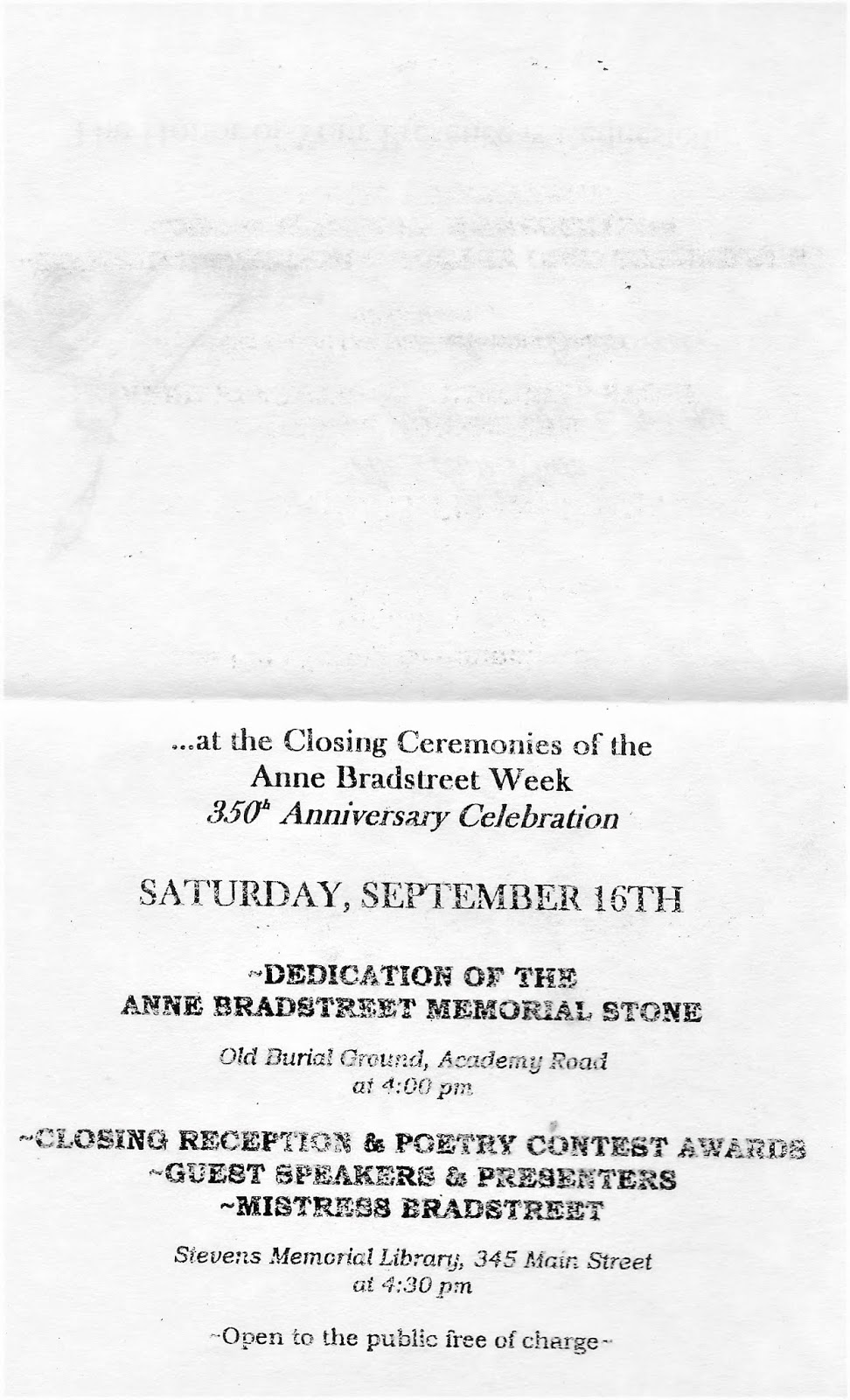
In September 2000, I was invited to attend the dedication of the Anne Bradstreet Memorial Stone at the Old Burying Ground in North Andover, Massachusetts. The date was chosen because it was the 350th anniversary of the first book of poetry written in America by Anne Bradstreet.

Below are items from that celebrated day.


Photos of plaques and the area of where Anne lived in Ipswich with her husband and where her father, Thomas Dudley lived is in my post at: https://lifefromtheroots.blogspot.com/2019/11/where-bradstreets-and-dudleys-lived-in.html

Tuesday, October 30, 2018

10th Annual Great Genealogy Poetry Challenge!

Every year prior to Thanksgiving, I enter Bill West's 10th Annual Great Genealogy Poetry Challenge! as described on his blog, West in New England. This is my 9th poem entry. To participate in this challenge, you have to follow several rules, the first being:

"Find a poem by a  poet, famous or obscure, about the region
one of your ancestors lived in. It can be about an historical event, a
legend, a person, or even about some place (like a river)or a local
animal."


Finding a poem this year, didn't take much research on my part because I've known for over 25 years that my ancestor, Anne Bradstreet, "America's First Poet" was my 8th great-grandmother. She wrote poems, and I'm sharing a few as my entry. I attended a dedication of her memorial stone (see what the invitees received) in September 2000, in North Andover, Massachusetts at the Old North Parish Burying Ground.


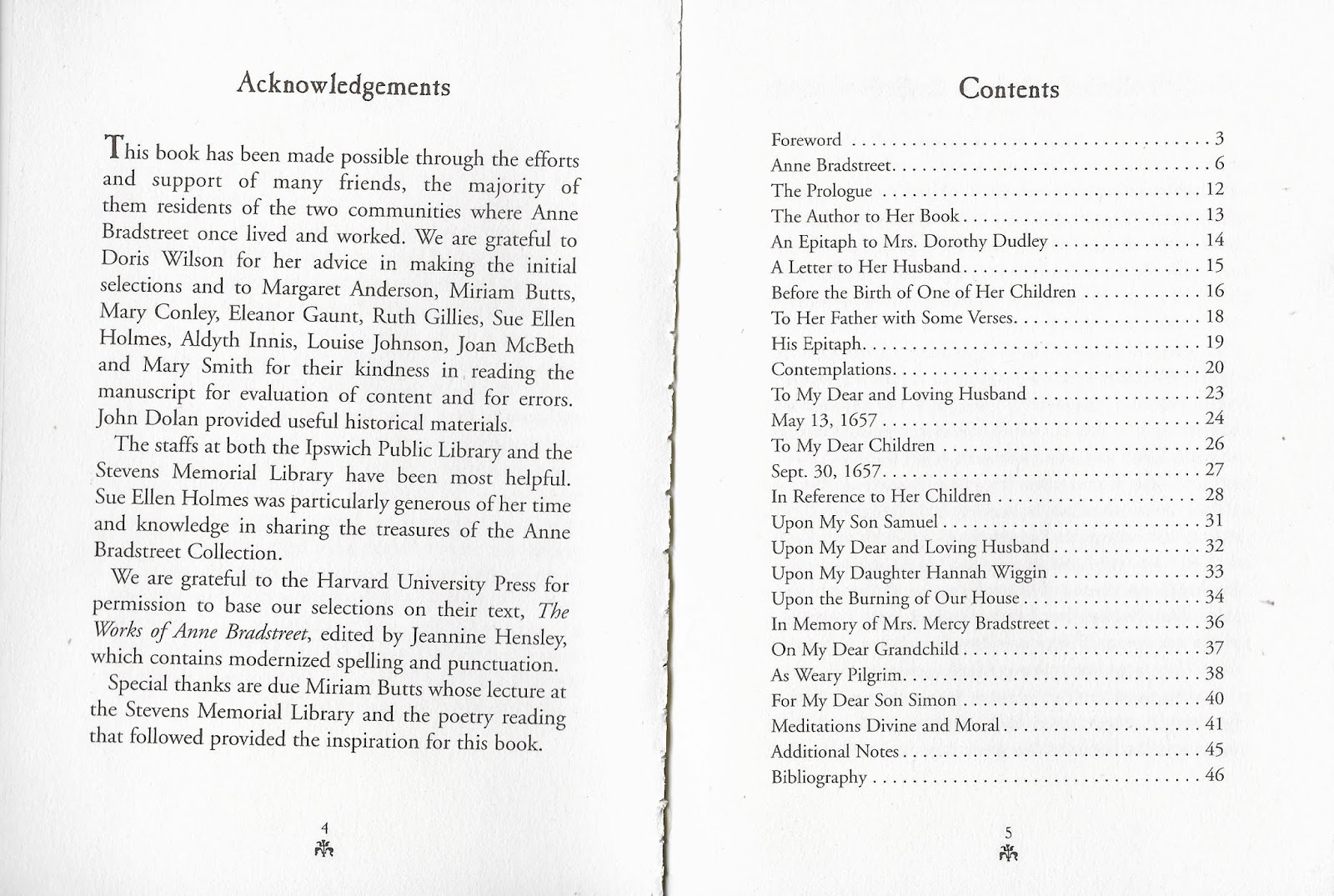
I bought the above small 47 page book at a book sale in Ipswich, Massachusetts about 10 years ago. It was published by the Library for 47 pages, sold for $1. original price  $8.95. The first four pages were scanned, because I wanted to show the Published information, Forward, Acknowledgements and a list of some of her poems.


An Epitaph on My Dear and Ever-honoured
Mother, Mrs. Dorothy Dudley Who Deceased
December 27, 1643, and of her Age 61.

A worthy Matron of unspotted life,
A loving Mother and obedient wife,
A friendly Neighbor, pitiful to poor,
Whom oft she fed, and clothed with her store;
To Servants wisely awful, but yet kind,
And as they did, so they reward did find:
A true Instructor of her Family,
The which she ordered with dexterity.
The public meetings ever did frequent,
And in her Closet constant hours she spent;
Religious in all her words and ways,
Preparing still for death, till end of days:
Of all her Children, Children, lived to see,
Then dying, left a blessed memory.


To My Dear and Loving Husband (Simon Bradstreet)

If ever two were one, then surely we.
If ever man were loved by wife, then thee.
If ever wife was happy in a man,
Compare with me, ye women, if you can.
I prize thy love more than whole mines of gold,
Or all the riches that the East doth hold.
My love is such that rivers cannot quench,
Nor ought but love from thee give recompense.
Thy love is such I can no way repay;
The heavens reward thee manifold, I pray.
Then while we live, in love let’s so persever,
That when we live no more, we may live ever.


Upon My Daughter Hannah Wiggin
Her Recovery from a Dangerous Fever

Blest be Thy name who didn't restore
To Health my daughter dear,
When death did seem ev'n to approach,
And life was ended near.

Grant she remember what Thous't done
And celebrate Thy praise
And let her conversation say
She loves Thee all Thy days.

Photo taken 10/2000 by Barbara Poole
Memorial stone for Anne Dudley Bradstreet


Other poems in this book, pertaining to her family, were:
Upon My Son Samuel His Going For England, Nov. 6, 1657.

To the Memory of My Dear Daughter-in-Law, Mrs. Mercy Bradstreet,
Who Deceased Sept. 6, 1669, in the 28th Year of Her Age. (Mercy Tyng).

In Reference to Her Children 23 June 1659.

I have decided not to use the Comment feature for my blog. If you would like to leave a comment for me or ask a question, please write me at my email: BarbaraPoole@Gmail.com. Thank you.

My reason is because since November 2017 to May 2018, I received no comments, but upon investigating I found that I had indeed received 167 legitimate ones and 1,000 were in the spam folder. Google Blogger had made some changes that I was unaware of. Please be aware that I do not know who reads my blog, I may know who subscribes, but that is all.

Monday, November 6, 2017

"On Learning To See," and I have David McCullough to Thank for the Poetry Challenge Idea

Church and tombstone of
Dr. Manasseh Cutler
For the past eight years, Bill West of West in New England blog has his Annual Great Genealogy Poetry Challenge. The fun that comes from this challenge is, I need to find a poem that has something to do with genealogy or an ancestor or distant relative with perhaps history or genealogy in the theme.

For my 7th annual poem I chose On learning to See by Jack Metthews. My poem idea was based on the fact that I learned, from a facebook friend, that David McCullough was writing a book with some information about my ancestor, my 5th great-grandfather, Manasseh Cutler! A little magical google searches brought me to this poem!


"McCullough is working on another book, 'The Pioneers,' which is scheduled for a 2019 release. The book will tell the story of the courageous first settlers of the Northwest Territory in the late 1700s and early 1800s, including Ohio University founder Manasseh Cutler."
My 2nd great-grandfather also wrote a book about Dr. Manasseh Cutler:
Poole, William Frederick, The The Ordinance of 1787, and Dr. Manasseh Cutler, Welch, Bigelow, and Co., University Press, Cambridge, Mass. : 1876. (Google book.)  I assume Mr. McCullough will use this book.

ON LEARNING TO SEE

By Jack Matthews

Ohio University's my theme,
An institution intellectuals planned
When Ohio was a wilderness, for they deemed
This to be the time and this the land.
It remained in isolation as it matured,
Silent and remote from most appeals
Of fame and noise, and in this way abjured
The insidious power that relevance conceals.

By nature universities aspire
To that which some in part achieve by chance;
But we far more than most this end acquire--
Being an institution of irrelevance.
What perspective is better from which to see
The world than from some vantage point apart?--
For this remoteness in itself will free
The mind and with it liberate the heart.
Without some distance, nothing can be known;
There is no fixedness without some motion;
Knowledge derives from antithesis alone--
No fish could ever understand the ocean.

Great numbers of distinguished men and women
Have studied in these halls; but I will summon
Only one who did not study here at all,
Yet left his mark indelibly, withal.
I speak of Manasseh Cutler, eponym
Of Cutler Hall, that still remains a hymn
Of architectural elegance, one Jefferson 
Himself would have put his name upon.

For Manasseh Cutler was a man
Much like Jefferson in his great command
Of knowledge--of philosophy and plants,
Of engineering, theology and dance,
Of physics, poetry and classic drama,
Of grammar, syntax, the function of the comma.
He was, in short, un Uomo Universale,
And as much as any human exempt from folly.

He understood the complexity of things
And how much satisfaction knowledge brings.
He understood the molecule and atom
And sensed those elements too deep to fathom.

So how do you open a university?
Manasseh Cutler did it with a key--
To wit, he consulted and studied the college charter
Of several, including Yale, his Alma Mater;
So our "Harvard on the Hocking"--as some have hailed it--
He patterned on its nemesis, he yaled it.

It was in his encyclopaedic brain
That a university was born, to gain
Its true and plenary self beyond his knowing--
As always the richest seed transcends its sowing.
This impulse in his mind became the brick
Of buildings in which debate, arithmetic
And botany were passionately instilled
In the young, ambitious to be skilled
In eastern sophistication, while retaining
Some frontier innocence and remaining
Idealistic in the firm belief
That in knowledge, and that alone, is our relief--
visionary in their firm conviction
That wisdom is the ultimate benediction.

For learning of this sort to be completed
a passionate attentiveness is needed.
We need the world of things to love and study
As surely as the mind requires a body.
To fervidly attend to what's provided
By a teeming world of things is to be guided
By the instinct of the mind, the signal feature
Of that thinking reed, the human creature.

How much there is we see but do not see;
How often things are instruments that we
Fail to honor with that rapt attention
The world deserves--I speak of deep absorption,
Of profound allegiance to the morality
Of understanding; I speak of responsibility;
Of how it is through learning that we seek
To better understand the world; I speak
Of Manasseh Cutler, whose son reported that
"He learned to see what he was looking at."

I obtained permission from reference librarian, Julia Robinson, to use this poem from Ohio University. I only wish the author, Jack Matthews could have been thanked personally.  Credit: https://www.ohio.edu/bicentennial/history/tributes/poem.cfm

"The following poem was commissioned by Dean Leslie Flemming of the College of Arts and Sciences to be read on the occasion of the Distinguished Alumni Ceremony on September 19, 2003 in the Baker Center Ballroom. The poem and preface were published in the program for the evening. 

Preface

A preface to a short poem can betray fecklessness or self-infatuation. And yet, prefaces can also be charitable acts, calculated to prepare audiences for what's in store for them, which is merciful insofar as poems are often perplexing when they are heard rather than read. So it's this I have in mind in providing the following introduction:

How can one pack the life of a 200-year-old university into a poem? Best not try, is the prudent answer; but, here, prudence is of limited usefulness; so that, when I was asked to do precisely this, I was happy to throw myself into the task. The result is a 2-page poem (if I had striven for historical balance, that would be one page a century) of closely rhymed pentameters.

Why rhymed? Because it is focused upon that gifted renaissance man who, in effect, started it all--Manasseh Cutler; and the verse most appropriate to him is that which he would most likely understand and appreciate if he were to hear it. More than that, however, such closely rhymed verse announces itself defiantly as artifice, rejecting the latent imposture of unrhymed, unmetered verse as a simulacrum of living speech, for poetry is not speech, but an elaboration upon the artifice of speech.

In addition to all this, however, to the modern ear there's always something faintly playful, frolicsome--even hilarious--about closed rhymes. It's hard to take them altogether seriously. Laughter is in their echoes, as surely as in the syllables, "Ha ha!" But no intellectual worthy of the name would ever deny the importance of laughter, for more often than not, laughter is nothing but a response to irony, and irony is intrinsic to language itself; and language defines our world."

Tributes

"Just learned in the spring 2014 obituaries of the passing of John “Jack” Matthews, Distinguished Professor Emeritus of Creative Writing at OHIO."

Two posts of mine, with photos, previously written:
Dr. Manasseh Cutler - A minister, doctor, statesman, botanist and ancestor

Hamilton Cemetery and Manasseh Cutler, the most accomplished of all my ancestors